
How Much Does Internet Marketing Cost? 2025 Pricing Guide for Small Businesses

Lightning Leads Pro / Internet Marketing Service / How Much Does Internet Marketing Cost? 2025 Pricing Guide for Small Businesses

Small business owners spend an average of 12.3% of revenue on marketing (1), yet many still wonder if they're paying too much or too little for internet marketing services. The confusion stems from dramatic price variations: one agency charges $500 monthly while another quotes $5,000 for what appears to be similar work.

This guide breaks down real internet marketing service costs, explains what drives price differences, and helps you determine the right budget for your business goals. You'll learn typical price ranges for common services, understand the pricing models agencies use, and discover how to evaluate whether you're getting fair value.

By the end, you'll have a realistic budget framework and know exactly what questions to ask providers. We've helped Tampa Bay area businesses build profitable marketing strategies, and we'll show you how to make informed decisions about your internet marketing investment.

What's the typical price range for digital marketing services?
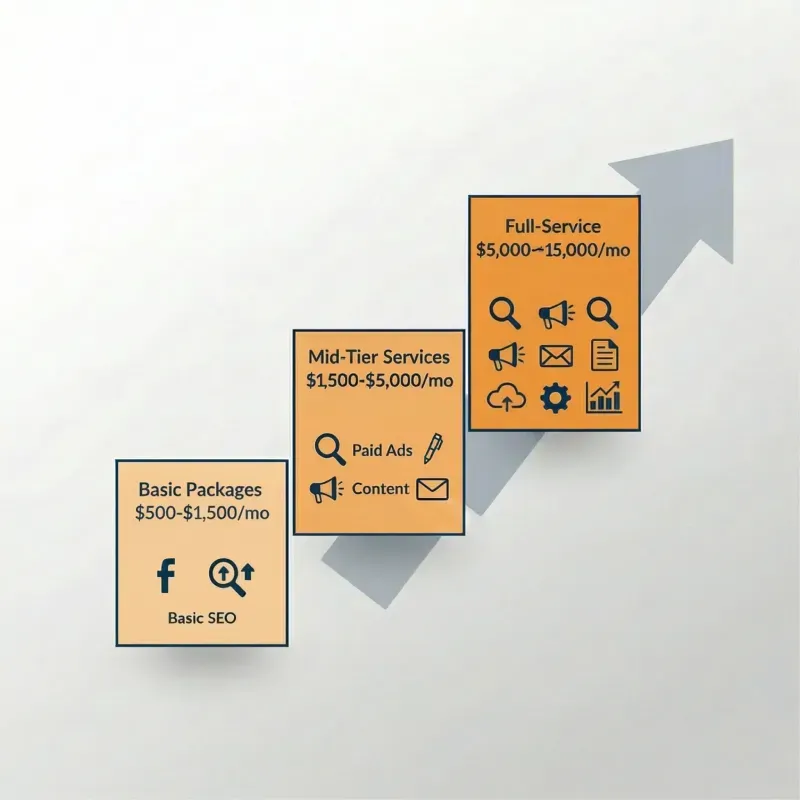
Stair-step infographic displaying three pricing tiers for an Internet Marketing Service, ranging from Basic Packages ($500-$1,500/mo) to Mid-Tier, and up to Full-Service options ($5,000-$15,000/mo) suitable for growing businesses in Tampa and Riverview.

Internet marketing service costs vary based on business size and scope:

Basic packages: $500-$1,500/month (social media management, basic SEO)

Mid-tier services: $1,500-$5,000/month (comprehensive SEO, PPC, content marketing)

Full-service marketing: $5,000-$15,000+/month (complete strategy, multiple channels, dedicated team)

Project-based work ranges from $1,000-$30,000 depending on deliverables. The U.S. Small Business Administration recommends small businesses with revenues less than $5 million allocate 7-8% of their revenues to marketing (2), with the specific percentage depending on your industry and growth stage.

See transparent pricing for internet marketing services in Riverview and get a custom quote based on your goals.

Internet marketing service costs vary based on business size and scope:

Basic packages: $500-$1,500/month (social media management, basic SEO)

Mid-tier services: $1,500-$5,000/month (comprehensive SEO, PPC, content marketing)

Full-service marketing: $5,000-$15,000+/month (complete strategy, multiple channels, dedicated team)

Project-based work ranges from $1,000-$30,000 depending on deliverables. The U.S. Small Business Administration recommends small businesses with revenues less than $5 million allocate 7-8% of their revenues to marketing (2), with the specific percentage depending on your industry and growth stage.

See transparent pricing for internet marketing services in Riverview and get a custom quote based on your goals.

What Influences Internet Marketing Service Pricing

Internet marketing costs vary widely because no two businesses face identical challenges. Understanding the factors that drive pricing helps you evaluate quotes and avoid overpaying or underinvesting.

Business size and market reach affect how much work your campaigns require. A single-location Riverview shop targeting local customers needs less intensive strategies than a multi-location business competing across Tampa Bay. Local campaigns focus on specific neighborhoods, while regional efforts demand broader content and more competitive keyword targeting.

Service scope determines monthly investment levels. Basic SEO alone costs less than combining SEO with paid advertising, social media, and content marketing. Each channel requires dedicated time for strategy, execution, and optimization. Agencies handling multiple channels need larger teams and more sophisticated tools.

Agency structure impacts what you pay. Solo freelancers have lower overhead but limited capacity. Boutique agencies like ours balance personalized service with specialized expertise. Large full-service firms charge premium rates for

Diagram illustrating the five main factors that affect the pricing of an Internet Marketing Service, including business size, service scope, and market competition, set against a subtle skyline background reminiscent of Tampa.

Internet marketing costs vary widely because no two businesses face identical challenges. Understanding the factors that drive pricing helps you evaluate quotes and avoid overpaying or underinvesting.

Business size and market reach affect how much work your campaigns require. A single-location Riverview shop targeting local customers needs less intensive strategies than a multi-location business competing across Tampa Bay. Local campaigns focus on specific neighborhoods, while regional efforts demand broader content and more competitive keyword targeting.

Service scope determines monthly investment levels. Basic SEO alone costs less than combining SEO with paid advertising, social media, and content marketing. Each channel requires dedicated time for strategy, execution, and optimization. Agencies handling multiple channels need larger teams and more sophisticated tools.

Agency structure impacts what you pay. Solo freelancers have lower overhead but limited capacity. Boutique agencies like ours balance personalized service with specialized expertise. Large full-service firms charge premium rates for extensive teams and enterprise-level tools.

Geographic competition drives strategy intensity. Breaking into Tampa's saturated market requires more aggressive tactics than ranking for niche professional services in Riverview. Highly competitive markets need larger content libraries, stronger backlink profiles, and more frequent optimization cycles.

Your starting point affects initial costs. Businesses with established websites and existing content need optimization and expansion. Starting from scratch requires building foundational elements like site architecture, initial content libraries, and basic technical SEO before growth strategies begin.

extensive teams and enterprise-level tools.

Geographic competition drives strategy intensity. Breaking into Tampa's saturated market requires more aggressive tactics than ranking for niche professional services in Riverview. Highly competitive markets need larger content libraries, stronger backlink profiles, and more frequent optimization cycles.

Your starting point affects initial costs. Businesses with established websites and existing content need optimization and expansion. Starting from scratch requires building foundational elements like site architecture, initial content libraries, and basic technical SEO before growth strategies begin.

Many Falkenburg businesses travel to customer locations rather than hosting clients on-site. Contractors, home services, and consultants drive to where customers need them. Your physical address matters less than the areas you serve.

Contractors, home services, and consultants serve customers in FishHawk Ranch and surrounding communities. You might install equipment in Boyette Springs, provide services in South Fork, or consult with clients in Waterset. Your service radius extends well beyond Falkenburg Road itself.

Service area pages target neighborhoods like Boyette Springs, South Fork, and Waterset. Each page on your website focuses on one specific area. This strategy helps you rank when customers in those neighborhoods search for your services.

Each page focuses on specific areas your business actually serves. We don't create content for locations you can't reach. The pages reflect real service zones where you take appointments and complete work.

This approach works well when you meet clients at their homes, offices, or neutral locations. You might meet at a customer's warehouse, their residence, or a coffee shop. Service area content matches how your business actually operates.

Local content demonstrates you understand the areas you cover. Mentioning access from I-75, parking at business centers, or serving HOA communities shows customers you know their neighborhood. This builds confidence before they contact you.

Common Internet Marketing Pricing Models Explained
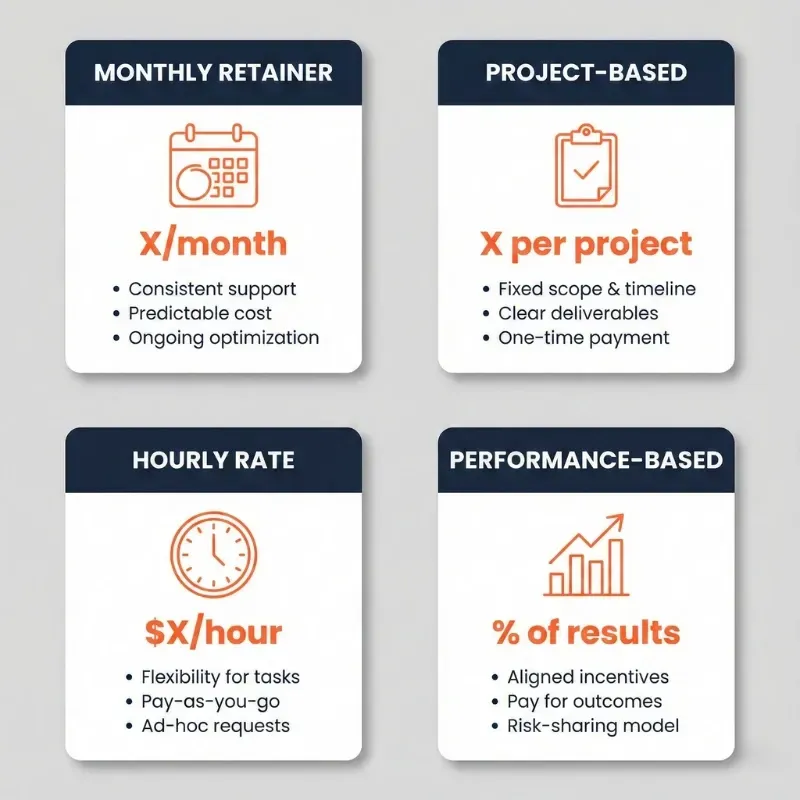
Four quadrants comparing payment models for an Internet Marketing Service: Monthly Retainer, Project-Based, Hourly Rate, and Performance-Based, helping business owners in Brandon and Riverview decide which structure fits their budget.

Agencies structure their fees in different ways. Knowing these models helps you compare proposals accurately and choose the arrangement that fits your business.

Monthly retainer agreements are the most common structure for ongoing services. You pay a fixed monthly fee for a predetermined set of deliverables and hours. Retainers provide predictable costs and consistent attention to your marketing. Most include monthly reporting, strategy adjustments, and a defined scope of work. This model works well for businesses needing continuous optimization and content creation.

Project-based pricing applies to one-time initiatives with clear endpoints. Website redesigns, comprehensive SEO audits, and campaign launches typically use this structure. Projects range from $1,000 for basic audits to $30,000+ for complex website builds with custom functionality. You receive detailed proposals outlining deliverables, timelines, and payment schedules. This model suits businesses tackling specific challenges rather than ongoing marketing needs.

Hourly consulting rates for digital marketing expertise typically range from $100 to $300+ per hour (3) depending on experience and specialization. Senior strategists and specialists command higher rates than general practitioners. Hourly arrangements work for businesses needing occasional guidance, audits, or technical problem-solving without committing to retainers.

Performance-based pricing ties fees to specific outcomes like leads generated or sales closed. Some agencies charge commissions on revenue or cost-per-lead arrangements. While this sounds attractive, be cautious. Performance models often require higher base fees to offset risk, and agencies may prioritize short-term results over sustainable growth. This structure works best when you have proven conversion rates and can accurately track attribution.

Hybrid models combine retainer fees with performance bonuses. You pay a base monthly rate for core services, plus additional compensation when campaigns exceed targets. This balances predictable costs with aligned incentives. We use this approach for clients who want consistent work with rewards for exceptional results.

Agencies structure their fees in different ways. Knowing these models helps you compare proposals accurately and choose the arrangement that fits your business.

Monthly retainer agreements are the most common structure for ongoing services. You pay a fixed monthly fee for a predetermined set of deliverables and hours. Retainers provide predictable costs and consistent attention to your marketing. Most include monthly reporting, strategy adjustments, and a defined scope of work. This model works well for businesses needing continuous optimization and content creation.

Project-based pricing applies to one-time initiatives with clear endpoints. Website redesigns, comprehensive SEO audits, and campaign launches typically use this structure. Projects range from $1,000 for basic audits to $30,000+ for complex website builds with custom functionality. You receive detailed proposals outlining deliverables, timelines, and payment schedules. This model suits businesses tackling specific challenges rather than ongoing marketing needs.

Hourly consulting rates for digital marketing expertise typically range from $100 to $300+ per hour (3) depending on

Your GBP listing appears in map results when people search near Falkenburg Road. When customers search for services in Riverview, Google shows a map with three local businesses. Your optimized profile increases the chances you're one of those three.

Proper category selection matters for Internet Marketing Service, contractor categories, and medical specialties. Google uses your primary category to determine which searches show your business. Choosing the wrong category means missing relevant searches entirely.

Regular posts, photos, and reviews improve your local ranking. Active profiles with recent content rank higher than abandoned listings. Weekly posts and monthly photo updates signal your business stays current.

Many customers check map results before visiting websites. They scan profiles for hours, services, and reviews. A complete GBP profile answers their questions without requiring them to leave Google.

Accurate service areas ensure you show up in the right neighborhood searches. Setting your service radius to include FishHawk, Boyette, and Bloomingdale makes you visible in those areas. Without proper settings, you miss nearby customers.

Business hours and contact info must stay current to avoid losing potential clients. Outdated hours frustrate customers who call during listed times. Wrong phone numbers send leads nowhere. Regular audits keep your information accurate.

experience and specialization. Senior strategists and specialists command higher rates than general practitioners. Hourly arrangements work for businesses needing occasional guidance, audits, or technical problem-solving without committing to retainers.

Performance-based pricing ties fees to specific outcomes like leads generated or sales closed. Some agencies charge commissions on revenue or cost-per-lead arrangements. While this sounds attractive, be cautious. Performance models often require higher base fees to offset risk, and agencies may prioritize short-term results over sustainable growth. This structure works best when you have proven conversion rates and can accurately track attribution.

Hybrid models combine retainer fees with performance bonuses. You pay a base monthly rate for core services, plus additional compensation when campaigns exceed targets. This balances predictable costs with aligned incentives. We use this approach for clients who want consistent work with rewards for exceptional results.

Breaking Down Costs by Service Type
Knowing specific price ranges for individual services helps you build realistic budgets and evaluate proposals. Here's what you can expect to invest in common internet marketing channels.

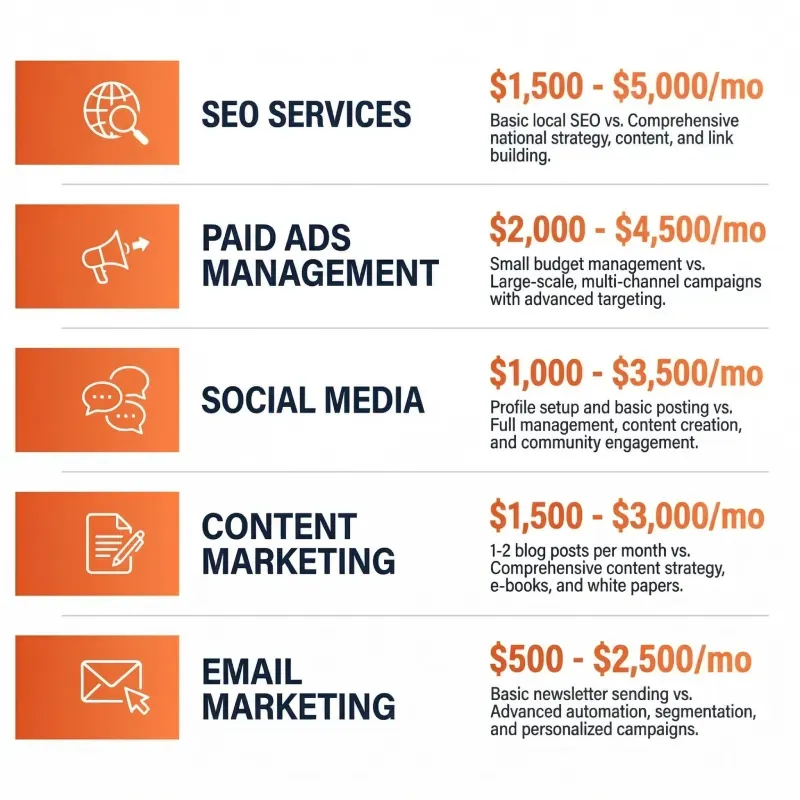
SEO services typically cost between $500 and $20,000+ per month (4) based on market competitiveness and campaign scope. Basic local SEO for a single-location business in Riverview starts around $500-$1,500 monthly. This includes Google Business Profile optimization, local citations, and foundational on-page work. Competitive markets like Tampa require $2,000-$5,000+ monthly for comprehensive strategies involving content creation, technical audits, and ongoing link building.

PPC management fees follow two models: flat monthly rates or percentage of ad spend. For ad budgets under $5,000 monthly, management fees run $500-$1,500. Ad budgets between $5,000-$15,000 typically cost $1,500-$3,000 in management fees. The percentage model charges 15-30% of total ad spend (5). Remember these are management fees only. Your actual advertising spend goes directly to Google or Facebook on top of agency fees.

Price breakdown chart listing monthly cost ranges for specific Internet Marketing Service channels, including SEO Services, PPC Management, Social Media, Content Marketing, and Email Marketing.

Knowing specific price ranges for individual services helps you build realistic budgets and evaluate proposals. Here's what you can expect to invest in common internet marketing channels.

SEO services typically cost between $500 and $20,000+ per month (4) based on market competitiveness and campaign scope. Basic local SEO for a single-location business in Riverview starts around $500-$1,500 monthly. This includes Google Business Profile optimization, local citations, and foundational on-page work. Competitive markets like Tampa require $2,000-$5,000+ monthly for comprehensive strategies involving content creation, technical audits, and ongoing link building.

PPC management fees follow two models: flat monthly rates or percentage of ad spend. For ad budgets under $5,000 monthly, management fees run $500-$1,500. Ad budgets between $5,000-$15,000 typically cost $1,500-$3,000 in management fees. The percentage model charges 15-30% of total ad spend (5). Remember these are management fees only. Your actual advertising spend goes directly to Google or Facebook on top of agency fees.

Social media marketing ranges from $300-$1,500 monthly for basic content planning and posting across platforms. Comprehensive management involving multiple platforms, custom graphics, video creation, and detailed analytics runs $1,500-$5,000 monthly (5). Higher-tier packages include community management, influencer outreach, and paid social advertising coordination.

Content marketing and blogging investments depend on volume and quality. Small businesses can start with $500 to $1,000 monthly for a basic digital presence combining organic social media, email marketing, and content creation (6). Professional blog posts cost $100-$500 per article depending on length, research depth, and writer expertise. Monthly programs combining strategy, content creation, and distribution typically run $1,000-$5,000.

Email marketing costs between $300 and $5,000 per month (7) including platform fees, list management, design, copywriting, and campaign analysis. Basic newsletters with simple templates fall on the lower end. Sophisticated automation sequences, segmentation strategies, and A/B testing push costs higher.

Ready to see what a custom internet marketing strategy would cost for your business? Get a free strategy session to discuss your specific goals and budget.

Social media marketing ranges from $300-$1,500 monthly for basic content planning and posting across platforms. Comprehensive management involving multiple platforms, custom graphics, video creation, and detailed analytics runs $1,500-$5,000 monthly (5). Higher-tier packages include community management, influencer outreach, and paid social advertising coordination.

Content marketing and blogging investments depend on volume and quality. Small businesses can start with $500 to $1,000 monthly for a basic digital presence combining organic social media, email marketing, and content creation (6). Professional blog posts cost $100-$500 per article depending on length, research depth, and writer expertise. Monthly programs combining strategy, content creation, and distribution typically run $1,000-$5,000.

Email marketing costs between $300 and $5,000 per month (7) including platform fees, list management, design, copywriting, and campaign analysis. Basic newsletters with simple templates fall on the lower end. Sophisticated automation sequences, segmentation strategies, and A/B testing push costs higher.

Ready to see what a custom internet marketing strategy would cost for your business? Get a free strategy session to discuss your specific goals and budget.

Neighborhood pages target searches like "service near FishHawk Ranch" or "contractor Boyette Springs." Customers search using neighborhood names when they want local providers. Pages built for these searches capture that traffic directly.

Each page addresses local details: access from I-75, parking at business parks, serving nearby HOA communities. You mention the Crosstown exit, the Texas Roadhouse corner at Causeway and Falkenburg, or the US-301 intersection. These references prove you know the area.

Manufacturing and distribution businesses on Falkenburg often need B2B marketing content. Your customers include other businesses, not homeowners. Content addressing supply chain needs, equipment services, or commercial partnerships speaks to your actual market.

Professional service providers benefit from content addressing clients in residential areas. If you serve homeowners in FishHawk Ranch or Boyette Springs, your content discusses residential needs. You talk about HOA requirements, property access, and neighborhood-specific considerations.

Local landmarks help with geographic relevance. Mentioning the Texas Roadhouse corner, Crosstown exit, or US-301 intersection ties your content to real places. Google recognizes these locations and connects them to local searches.

Blog posts about serving specific Riverview areas improve your overall domain authority. Regular content about local projects, neighborhood trends, or area-specific services builds your site's relevance. Each post strengthens your rankings for location-based searches. Discover our local content creation services for Riverview businesses.

Red Flags and Value Indicators When Comparing Quotes
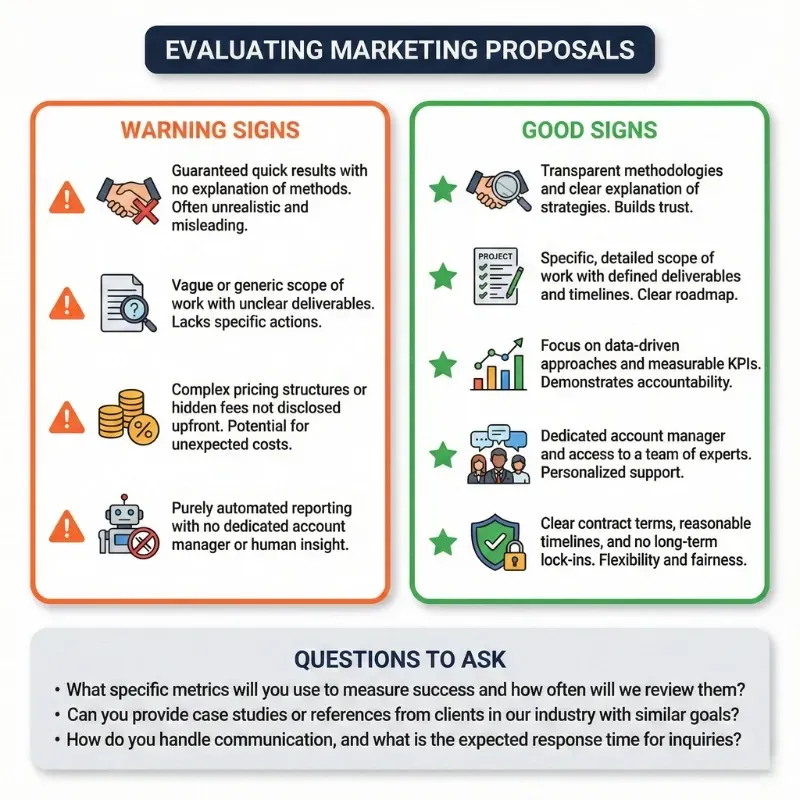
A comparison guide titled "Evaluating Marketing Proposals" showing warning signs versus good signs when hiring an Internet Marketing Service, along with key questions to ask agencies in the Tampa Bay area.

Not all marketing services deliver equal value. Knowing how to spot warning signs and identify genuine expertise protects your investment and helps you choose partners who drive real results.

Warning signs of overpricing include proposals with vague deliverables like "comprehensive SEO" or "social media growth" without specific metrics or tasks. You should see exactly what you're paying for: number of blog posts, ad campaigns managed, keywords targeted, or reports delivered. Long contract lock-ins without performance guarantees force you to pay regardless of results. Hidden fees for basic services like monthly reporting or strategy calls suggest inflated pricing.

Red flags in budget services often signal poor quality or unsustainable practices. Agencies guaranteeing first-page rankings violate Google's guidelines and risk penalties that damage your site long-term. Automated reporting with no human analysis provides data without insights or recommendations. Offshore teams with no local market knowledge struggle to create content that resonates with Tampa Bay customers or understand regional search patterns.

Value indicators worth paying for include transparent reporting that explains what happened, why it matters, and what comes next. Dedicated account managers who know your business provide consistent communication and strategic guidance. Proven case studies in your industry demonstrate relevant experience and measurable results. Ask to see examples of work similar to your needs.

Questions to ask during proposal review help you evaluate true value. What exactly am I getting each month? Who will actually do the work on my account? How do you measure success, and when should I expect to see results? What happens if we're not satisfied with performance? How do you stay current with algorithm updates and industry changes? Direct answers to these questions separate experienced professionals from vendors reading from scripts.

Understanding the relationship between price and realistic timelines prevents frustration. SEO takes 3-6 months to show significant results regardless of what you pay. Agencies promising immediate rankings either use risky tactics or don't understand how search engines work. Higher monthly investments accelerate results by funding more content, stronger outreach, and faster technical improvements, but they don't eliminate the time Google needs to recognize and reward your improvements.

Not all marketing services deliver equal value. Knowing how to spot warning signs and identify genuine expertise protects your investment and helps you choose partners who drive real results.

Warning signs of overpricing include proposals with vague deliverables like "comprehensive SEO" or "social media growth" without specific metrics or tasks. You should see exactly what you're paying for: number of blog posts, ad campaigns managed, keywords targeted, or reports delivered. Long contract lock-ins without performance guarantees force you to pay regardless of results. Hidden fees for basic services like monthly reporting or strategy calls suggest inflated pricing.

Red flags in budget services often signal poor quality or unsustainable practices. Agencies guaranteeing first-page rankings violate Google's guidelines and risk penalties that damage your site long-term. Automated reporting with no human analysis provides data without insights or recommendations. Offshore teams with no local market knowledge struggle to create content that resonates with Tampa Bay customers or understand regional search patterns.

We operate virtually with Zoom meetings as the primary consultation method. Most consultations happen online through video calls. This saves you travel time and fits into your busy schedule.

No need to travel - most Falkenburg Road business owners prefer virtual meetings that fit their schedule. You can join from your office, warehouse, or job site. Virtual meetings eliminate the back-and-forth of finding convenient meeting times and locations.

In-person meetings can be arranged at convenient locations throughout Riverview if preferred. Some business owners like face-to-face discussions before starting a project. We accommodate that preference when requested.

Popular meeting spots include coffee shops near Causeway Boulevard, US-301, and FishHawk areas. Foxtail Coffee or other neutral locations work well for initial consultations. Choose a spot close to your business or near a project site.

We serve businesses throughout the Falkenburg Road corridor, Brandon, Bloomingdale, and eastern Hillsborough County. Your location on Falkenburg puts you in our primary service area. We work with industrial businesses, contractors, and professional services throughout this region.

Virtual approach works well for industrial businesses, contractors, and professionals with busy schedules. You don't need to block out hours for meetings. Join a call between appointments, during lunch, or after hours when convenient.

Value indicators worth paying for include transparent reporting that explains what happened, why it matters, and what comes next. Dedicated account managers who know your business provide consistent communication and strategic guidance. Proven case studies in your industry demonstrate relevant experience and measurable results. Ask to see examples of work similar to your needs.

Questions to ask during proposal review help you evaluate true value. What exactly am I getting each month? Who will actually do the work on my account? How do you measure success, and when should I expect to see results? What happens if we're not satisfied with performance? How do you stay current with algorithm updates and industry changes? Direct answers to these questions separate experienced professionals from vendors reading from scripts.

Understanding the relationship between price and realistic timelines prevents frustration. SEO takes 3-6 months to show significant results regardless of what you pay. Agencies promising immediate rankings either use risky tactics or don't understand how search engines work. Higher monthly investments accelerate results by funding more content, stronger outreach, and faster technical improvements, but they don't eliminate the time Google needs to recognize and reward your improvements.

How to Determine Your Internet Marketing Budget

Creating a realistic marketing budget requires balancing industry benchmarks with your specific business goals. Here's a practical framework for calculating the right investment level.

Revenue-based approach provides the simplest starting point. The U.S. Small Business Administration recommends small businesses with revenues less than $5 million allocate 7-8% of their revenues to marketing (2). A Riverview business generating $500,000 annually would budget $35,000-$40,000 for marketing, or roughly $3,000-$3,300 monthly. B2C companies typically need higher percentages between 5-10% compared to B2B companies at 2-5% (2) because consumer businesses require more touchpoints to drive purchases.

Goal-based budgeting works backward from desired outcomes. Calculate your customer lifetime value and acceptable acquisition cost. If each new customer generates $2,000 in profit over their relationship with your business, spending $400 to acquire them maintains healthy margins. Multiply your monthly customer goal by this acquisition cost to determine your minimum marketing investment. This method ensures spending aligns directly with growth targets.

Pie chart showing a recommended budget allocation strategy for an Internet Marketing Service. 70% to proven channels, 20% to optimization, and 10% to new tests, including a calculation example for a Tampa Bay business.

Creating a realistic marketing budget requires balancing industry benchmarks with your specific business goals. Here's a practical framework for calculating the right investment level.

Revenue-based approach provides the simplest starting point. The U.S. Small Business Administration recommends small businesses with revenues less than $5 million allocate 7-8% of their revenues to marketing (2). A Riverview business generating $500,000 annually would budget $35,000-$40,000 for marketing, or roughly $3,000-$3,300 monthly. B2C companies typically need higher percentages between 5-10% compared to B2B companies at 2-5% (2) because consumer businesses require more touchpoints to drive purchases.

Goal-based budgeting works backward from desired outcomes. Calculate your customer lifetime value and acceptable acquisition cost. If each new customer generates $2,000 in profit over their relationship with your business, spending $400 to acquire them maintains healthy margins. Multiply your monthly customer goal by this acquisition cost to determine your minimum marketing investment. This method ensures spending aligns directly with growth targets.

Competitive analysis approach examines what successful competitors invest in your market. Research similar businesses in Tampa Bay to understand typical spending levels. If competitors ranking above you invest $3,000 monthly in SEO while you spend $500, you'll struggle to compete for the same keywords and audiences. Matching or slightly exceeding competitor investment levels accelerates your ability to capture market share.

Phased investment strategy allows you to start conservatively and scale based on results. Begin with foundational services like local SEO and Google Business Profile optimization at $500-$1,500 monthly. Track results for 3-6 months. As you see positive ROI, add complementary channels like content marketing or paid advertising. This approach minimizes risk while building momentum toward larger campaigns.

Channel allocation model distributes your budget strategically across proven and experimental tactics. Invest 70% in channels already generating results, 20% in optimizing those channels for better performance, and 10% in testing new opportunities. A $3,000 monthly budget would allocate $2,100 to your core SEO work, $600 to improving conversion rates and landing pages, and $300 to testing new content formats or advertising platforms.

Schedule a free strategy session to get detailed pricing tailored to your business goals and budget in the Tampa Bay area.

Competitive analysis approach examines what successful competitors invest in your market. Research similar businesses in Tampa Bay to understand typical spending levels. If competitors ranking above you invest $3,000 monthly in SEO while you spend $500, you'll struggle to compete for the same keywords and audiences. Matching or slightly exceeding competitor investment levels accelerates your ability to capture market share.

Phased investment strategy allows you to start conservatively and scale based on results. Begin with foundational services like local SEO and Google Business Profile optimization at $500-$1,500 monthly. Track results for 3-6 months. As you see positive ROI, add complementary channels like content marketing or paid advertising. This approach minimizes risk while building momentum toward larger campaigns.

Channel allocation model distributes your budget strategically across proven and experimental tactics. Invest 70% in channels already generating results, 20% in optimizing those channels for better performance, and 10% in testing new opportunities. A $3,000 monthly budget would allocate $2,100 to your core SEO work, $600 to improving conversion rates and landing pages, and $300 to testing new content formats or advertising platforms.

Schedule a free strategy session to get detailed pricing tailored to your business goals and budget in the Tampa Bay area.

Local search results change as competitors improve their own SEO. Other businesses invest in optimization to outrank you. Rankings you achieve today can slip without continued maintenance. Staying visible requires ongoing attention.

Regular content updates signal to Google your business stays active. Fresh blog posts, updated service pages, and new photos show you're operating and engaged. Google favors active businesses over stale profiles and outdated websites.

Review monitoring and responses build trust with potential customers. New reviews appear regularly on your GBP profile. Responding quickly shows you value customer feedback. Unaddressed negative reviews hurt your reputation and rankings.

Citation cleanup fixes incorrect business information across directories. Your business name, address, and phone number appear on dozens of sites. Inconsistent information confuses Google and customers. Regular audits correct these errors.

Monthly reporting shows which keywords drive traffic and calls. You see which searches bring visitors to your site. This data guides future content and optimization decisions. You invest more in what works and adjust what doesn't.

Seasonal adjustments help contractors and service businesses during busy periods. Demand shifts throughout the year for many Falkenburg businesses. SEO adjustments capture seasonal searches when customers need you most.

Schedule your Brandon-Riverview SEO consultation today โ†’

Conclusion

Internet marketing costs vary widely based on your business size, market competitiveness, and goals, but understanding the factors behind pricing helps you make informed decisions. Most small businesses should allocate 7-8% of revenue to marketing (2), with specific channel investments ranging from $500 monthly for basic local SEO to $5,000+ for comprehensive multi-channel campaigns.

The key to successful internet marketing isn't finding the cheapest option or spending the most money. It's investing strategically in services that align with your business objectives, working with transparent providers who demonstrate measurable results, and scaling your budget as you prove ROI.

Start by focusing on foundational services like local SEO and Google Business Profile optimization, then expand into additional channels as you see positive returns. Track your customer acquisition costs, monitor performance metrics, and adjust your strategy based on real data rather than guesswork.

We help Tampa Bay area businesses build profitable internet marketing strategies that fit their budgets and deliver measurable growth. Schedule a free strategy session today to discuss your specific needs and get transparent pricing for services tailored to your goals.

Understanding the strategic frameworks behind effective marketing helps you evaluate whether a provider thinks strategically or just executes tactics.

The 3-3-3 rule structures campaigns for maximum reach and efficiency (10). Focus on three platforms where your customers actually spend time, three content types that match how they consume information, and three audience segments with distinct needs. For a Riverview home services company, this might mean Google search, Facebook, and your website as platforms. Blog posts, service pages, and video testimonials as content types. New homeowners, existing customers, and commercial property managers as segments. This prevents spreading resources too thin across channels that don't matter to your business.

The 7x7 marketing principle recognizes that customers need seven touchpoints across seven channels before they're ready to buy (11). Research shows the modern buying journey involves multiple interactions before conversion. For local service businesses, these touchpoints typically include Google search, your Google Business Profile, website visit, reviews check, Facebook page, phone call, and email confirmation. Quality services map these touchpoints deliberately rather than hoping customers stumble through them randomly.

The 50-30-20 content distribution strategy balances what you publish on social media (12). Dedicate 50% of posts to engagement content that starts conversations and builds relationships. Use 30% for informational content that educates and establishes expertise. Reserve 20% for promotional content about your services and offers. This ratio keeps your audience engaged without turning your social channels into constant sales pitches. Most businesses flip this backwards, leading to poor engagement and declining reach.

Why these principles matter goes beyond following trendy frameworks. Consistency across multiple channels builds recognition and trust. Testing within structured guidelines helps you identify what works without chaotic experimentation. Avoiding over-reliance on single channels protects you when algorithms change or platforms decline. Quality providers use these frameworks as starting points, then adapt based on your specific results.

How good services apply frameworks shows in their process. Strategic planning sessions at the start identify which principles fit your business model and market. Quarterly reviews assess whether the frameworks still serve your goals or need adjustment. Documented strategy keeps everyone aligned on why you're doing what you're doing, not just what tasks are getting done. This strategic thinking separates agencies that optimize for results from those that simply check boxes.

In our Riverview campaigns, we use the 7x7 principle to map out customer journeys for local service businesses. Those seven touchpoints typically include Google search for your service, seeing your business in the map pack, clicking to your website, reading customer reviews, checking your Facebook page for recent activity, calling your phone number, and receiving email confirmation. Understanding this journey helps us strengthen each touchpoint rather than hoping one great ad does all the work.

Local search results change as competitors improve their own SEO. Other businesses invest in optimization to outrank you. Rankings you achieve today can slip without continued maintenance. Staying visible requires ongoing attention.

Regular content updates signal to Google your business stays active. Fresh blog posts, updated service pages, and new photos show you're operating and engaged. Google favors active businesses over stale profiles and outdated websites.

Review monitoring and responses build trust with potential customers. New reviews appear regularly on your GBP profile. Responding quickly shows you value customer feedback. Unaddressed negative reviews hurt your reputation and rankings.

Citation cleanup fixes incorrect business information across directories. Your business name, address, and phone number appear on dozens of sites. Inconsistent information confuses Google and customers. Regular audits correct these errors.

Monthly reporting shows which keywords drive traffic and calls. You see which searches bring visitors to your site. This data guides future content and optimization decisions. You invest more in what works and adjust what doesn't.

Seasonal adjustments help contractors and service businesses during busy periods. Demand shifts throughout the year for many Falkenburg businesses. SEO adjustments capture seasonal searches when customers need you most.

Schedule your Brandon-Riverview SEO consultation today โ†’

The #1 Riverview Local SEO Agency That Delivers Real Results.

A bold, black-and-white graphic of a flag design with a single star in the canton and horizontal stripes, with the words "VETERAN OWNED" displayed prominently beneath it. This indicates a business is owned by a military veteran.

Contact

(813) 548-3740

10922 Green Harvest Dr.

Riverview, FL 33578

Hours of Operations

Mon - Sun | Open 24 Hrs

Brandon Riverview Chamber of Commerce Logo

ยฉ 2025 Lightning Leads Pro. All rights reserved.