HVAC postcards can still bring in calls, but only when the right card reaches the right homes. For most HVAC companies, the best first mailing goes to past customers. They already know your name, and you already have their address.
Every Door Direct Mail and bought mailing lists reach new homes instead. They are harder to judge, and you pay to reach people who have never heard of you. This guide compares the three options, shows a sample cost and explains how to tell if a mailing worked.
Key takeaways
- Direct mail is worth it only when you can trace the calls and jobs it brings.
- Postcards to past customers are often the best fit, since you own the list and they already know you.
- Every Door Direct Mail reaches every address on the postal routes you pick, with no list to buy.
- Put your business name exactly as it reads on your Google Business Profile, plus one phone number and your website.
- Print a short web address that appears only on the card, and ask every caller how they heard about you.
Is direct mail worth it for an HVAC company?
Direct mail is a paid channel, like ads. It is worth it when you can trace the calls it brings and the jobs pay for the mailing. It is not worth it when you mail and hope.
You will see response rates quoted on many marketing sites. We left them out of this guide on purpose. Most come from companies that sell mail, and few link to the study behind the number. Your own tracking is the number that counts.
Mail tends to fit an HVAC company in a few clear cases:
- You have a list of past customers who are due for a tune-up.
- A season is about to start. You want your name in front of homes before the first cold or hot week.
- You want more work in the neighborhoods closest to your shop.
- You have a real offer, such as a maintenance plan, that gives people a reason to call now.
Mail is a poor fit when you have no way to trace calls. It is also a poor fit when your online presence is not ready. Some people who get your card may look you up on Google before they call.
So check what they will find first. Our Google Business Profile management service helps you keep your profile complete and current. A card works alongside your local SEO work, not in place of it.
Option 1: Every Door Direct Mail from USPS
Every Door Direct Mail, or EDDM, is a USPS service. It delivers your mail piece to every address on the local postal routes you pick. You do not need names or street addresses. The cards are addressed to “Postal Customer” instead.
You pick routes on a map in the EDDM Online Tool. USPS says you can filter routes by age, household size and income, based on U.S. Census data. Each route you pick gets the card at every address on it.
Size and weight rules
EDDM takes flat-size mail, not small postcards. The USPS Domestic Mail Manual rules for EDDM Retail set the size. A piece must be longer than 10.5 inches or taller than 6.125 inches. A piece thicker than 0.25 inch also counts. Each piece can weigh no more than 3.3 ounces.
So a standard 4 by 6 inch postcard does not qualify. Ask your printer for an EDDM size, and use the size checker in the EDDM tool before you print.
Retail or commercial (BMEU)
USPS offers two ways to send EDDM. The prices below are from the USPS EDDM page at the time of writing.
- EDDM Retail is built for small businesses. You need a USPS.com account but no mailing permit. You drop the cards at the Post Office. Postage is $0.26 a piece.
- EDDM BMEU is built for large mailers. You need a Business Customer Gateway account and a bulk mailing permit. You drop the cards at a USPS Business Mail Entry Unit (BMEU). Postage is as low as $0.259 a piece.
A Retail mailing needs at least 200 pieces, unless you mail every address in a ZIP Code with fewer than 200. You can send up to 5,000 pieces a day per ZIP Code. Many printers can also bundle and drop the mailing for you.
Keep the tradeoff in mind. EDDM reaches every address on a route, including renters and homes you may not want to serve. You pay for each of those cards.
Option 2: A targeted mailing list
A targeted list is a set of addresses you rent or buy from a list provider. You choose filters such as homeowners, the age of the home or certain ZIP Codes. Each card then carries a name and an address.
This puts your card in front of homes that may fit your work better than a whole route. It also costs more, since you pay for the list on top of printing and postage. The quality of the list matters as much as the card.
Ask any list provider these questions before you pay:
- Where does the data come from, and how often is it updated?
- Can I use the list once, or can I mail it again?
- Can I remove my current customers so I do not pay to mail them twice?
- Will you show list, print and postage as separate lines on the quote?
Option 3: Postcards to past customers
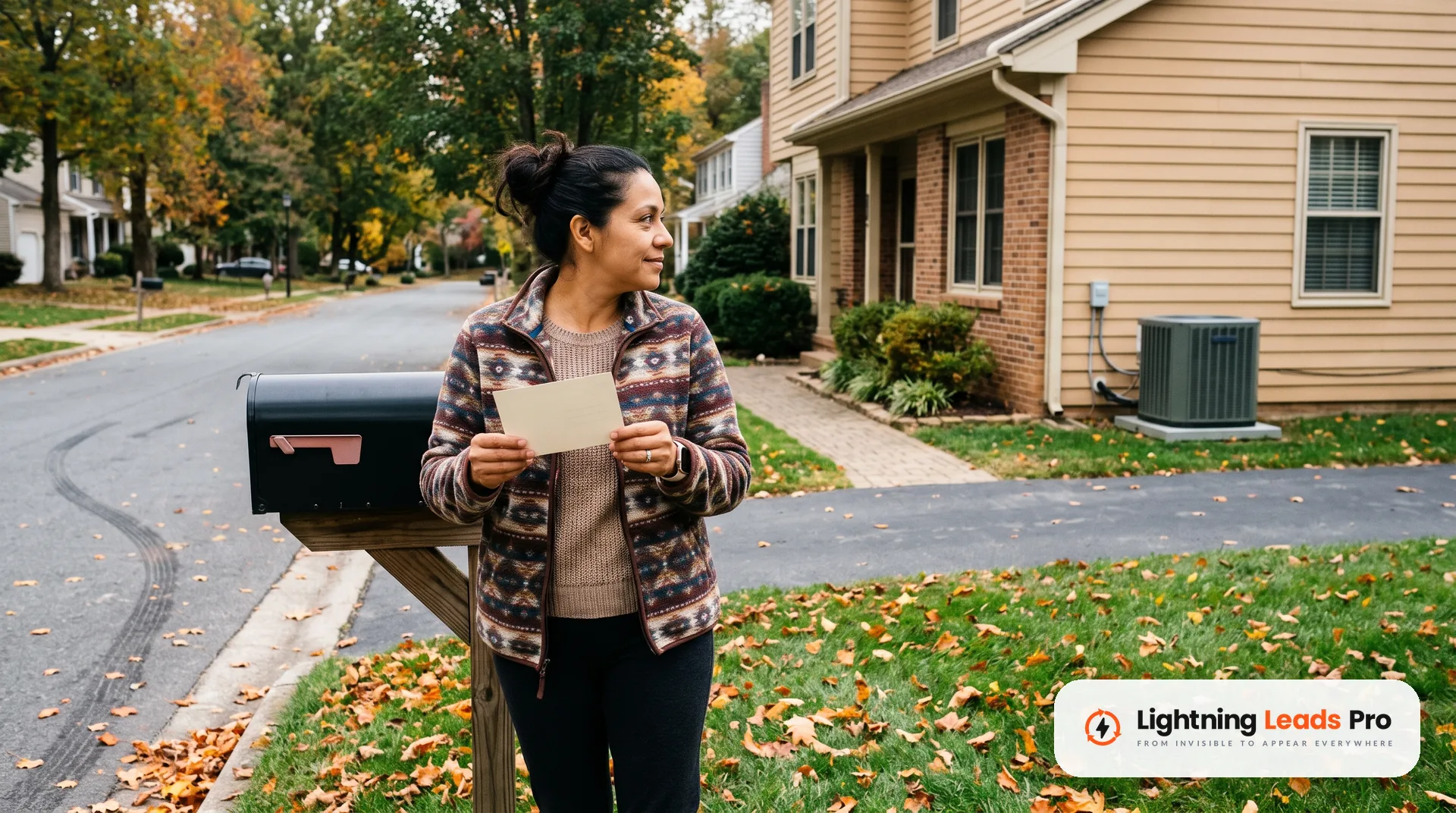
Postcards to past customers are often the best fit for an HVAC company. You already own the list, from your invoices or your customer records. These people have hired you before, and they know your trucks and your techs.
Use these cards for reasons a customer will care about. Good examples include a fall heating tune-up, a spring AC check, a filter reminder or a maintenance plan renewal. Keep one reason per card.
Small cards can go at the First-Class postcard price. USPS says standard postcard stamps start at $0.65 at the time of writing. The card must meet the USPS postcard size limits. That means at least 3.5 by 5 inches and no more than 4.25 by 6 inches.
Clean the list before each mailing. Remove people who moved, closed accounts and anyone who asked not to be contacted. Mail also reaches customers who skip your emails, so it pairs well with HVAC email marketing to the same list.
HVAC postcards and direct mail: the three options compared
Here is how the three options compare side by side.
| Option | Who gets it | Fits best for | Watch for |
|---|---|---|---|
| Every Door Direct Mail | Every address on the postal routes you pick | Reaching new homes near your best jobs | You pay for homes you do not serve |
| Targeted mailing list | Addresses that match the filters you choose | New homeowners or older homes in your area | List cost and quality vary by provider |
| Past customers | People who already hired you | Tune-up reminders, renewals and repeat work | A smaller list that needs regular cleanup |
A sensible order is to start with past customers, then test one EDDM drop near your busiest neighborhoods. Judge each option by its own calls before you mail more.
Not sure which homes are worth mailing first? Book a Free Local Lead Growth Session and we will show you which businesses show up ahead of you on Google.
What a sample mailing costs
Prices change by printer, size, paper and quantity. So here is one sample, not a quote. Conquest Graphics, a commercial printer, lists sample EDDM prices on its site, checked on Nov. 9, 2026.
- A 6.25 by 9 inch postcard at 1,000 pieces: 54 cents each, or about $540.
- The same card at 5,000 pieces: 30 cents each, or about $1,500.
- The printer says its sample prices include postage and delivery to the post office.
For scale, USPS Retail EDDM postage alone on 1,000 cards is $260 at $0.26 a piece. The printer also notes that prices may vary by route and by the options you choose. Ask whether design is included before you compare quotes.
Treat the mailing as one line in your yearly plan, not a one-off spend. Our guide to the HVAC marketing budget shows how to split money across channels and seasons.
What to put on an HVAC postcard
Most people glance at a postcard for only a moment. Keep it simple, and make the next step clear. Put these items on every card:
- Your business name exactly as it reads on your Google Business Profile, in the same words and order.
- One phone number, the same one that is on your profile. Make it large and easy to read.
- Your website, written short so it is easy to type.
- A short web address made only for this mailing, such as your site plus /tuneup. More on this below.
- What you do, in a few words, such as heating repair or AC tune-ups.
- One offer, only if you have a real one. Skip the offer rather than make one up.
A real photo of your tech or your van can help people know you when you show up. Leave room on the back for the address area. On EDDM Retail cards, USPS requires its postage mark above and to the right of the address block.
Leave off a second phone number, a long list of services and small print nobody can read. Each extra item makes the main one harder to find.
How to measure calls from a mailing
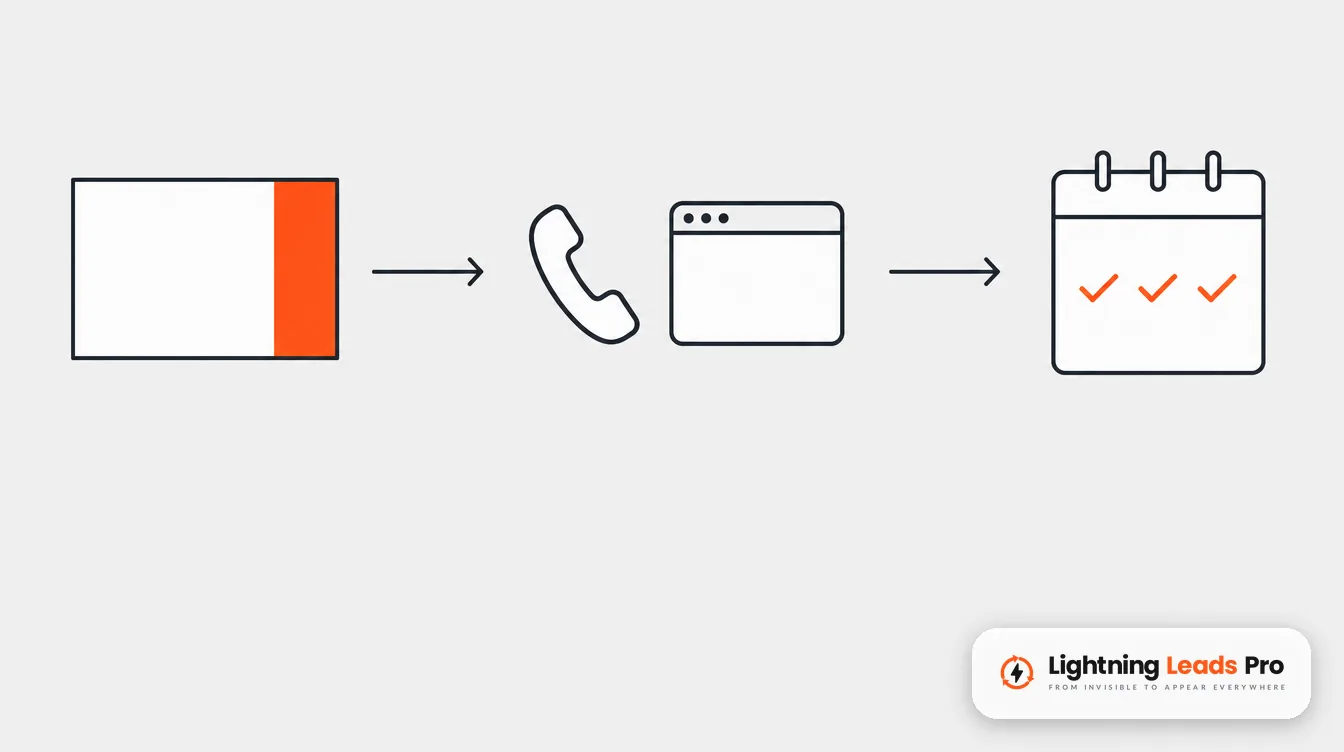
Tracking is what tells you if direct mail is worth it. Set it up before the cards print, not after the calls come in.
- Print a page only the card uses. Create a short page, such as your site plus /tuneup, and put it only on the postcard. Visits to that page came from the card.
- Ask every caller how they heard about you. Have whoever answers the phone ask and log the answer, every time.
- Add a code word. Ask people to mention a word from the card when they call or book.
- Write down the drop date. Compare calls in the weeks after the cards land with the weeks before.
- Count booked jobs and revenue. A call that never books does not pay for the mailing.
Keep the one phone number that is on your profile. Use the page, the question and the code word to trace calls instead.
Then judge each mailing on its own. Mail a second round only to the list or routes that brought booked jobs.
Frequently asked questions
Does direct mail still work for HVAC companies?
It can, when the cards go to the right homes and you track the results. Past customers are often the best place to start. Judge any mailing by booked jobs, not by how many cards went out.
How much do HVAC postcards cost?
It depends on size, paper, quantity and postage. One printer’s sample EDDM price, checked Nov. 9, 2026, was 54 cents a card at 1,000 pieces, postage included. Get two or three written quotes for your exact card.
What size postcard can I send with Every Door Direct Mail?
EDDM takes flat-size pieces. Under USPS rules, a piece must be longer than 10.5 inches or taller than 6.125 inches. It must also weigh 3.3 ounces or less, so a standard 4 by 6 inch postcard does not qualify.
Can I send EDDM only to homeowners?
No. EDDM goes to every address on the routes you pick. You can choose residential addresses only and filter routes by census data. To reach homeowners only, use a targeted mailing list.
How often should I mail past customers?
One simple plan is a card before each season. Think of a fall heating tune-up and a spring AC check. Mail when you have a real reason to reach out. Let your tracking tell you whether more often pays off.
Make every card point to a business that is easy to find
A postcard starts the conversation. What people find when they look you up can decide whether they call. Your name, number and website should match everywhere.
Want to see what homeowners find when they look up your company? Book a Free Local Lead Growth Session and we will walk you through it.