Published rules of thumb put an HVAC marketing budget somewhere between 5 and 15 percent of revenue. That is a wide range, because the sources do not agree. On a $1,000,000 company, it means $50,000 to $150,000 a year.
Those figures are rules of thumb from other companies, not our numbers and not industry law. This guide shows who says what, then helps you pick your own number for 2027. You will also see how to split it and how to judge it.
Key takeaways
- Most published ranges fall between 5 and 15 percent of revenue, with no official benchmark we could find.
- Sources tend to put newer companies at the high end, and established companies with repeat work lower.
- Split your budget between channels you keep, like your profile and website, and rented ones, like ads and lead sites.
- Keep long-term work steady all year, and let ad spend rise and fall with your seasons.
- Judge every dollar by cost per booked job, not by clicks or lead counts.
How much to spend on HVAC marketing: what the sources say
Here is what four sources say. We opened each page and read the figures ourselves.
- BDR: 5 to 10 percent of total revenue for most contractors. In active growth, it says 10 to 12 percent or more (June 2026).
- Hook Agency: 7 to 10 percent of annual revenue for small to midsize HVAC companies. The same page notes some sources say most small businesses spend 2 to 5 percent (edited November 2025).
- Marketing 360: 10 to 15 percent of gross revenue. It says near 10 to hold your share and closer to 15 for new shops or aggressive growth (undated page).
- Cornerstone Advertising: 10 percent of gross revenue for growth, from founder Tracy Paul. It appears in a webinar recap on the ACCA blog (December 2025).
Keep one thing in mind as you read these. All four sell marketing services, and so do we. Treat every range as a starting point, including the ones on this page.
The sources also measure from different places. BDR and Hook Agency use your revenue. Tracy Paul applies the 10 percent to the revenue you want to reach, not your current revenue. On a growth year, that alone can change your number by a lot.
Is there an official HVAC advertising budget number?
We did not find one. We checked the SBA’s marketing guidance, and it gives no percentage. It tells you to break down your costs and compare them to the revenue they generate.
A 2019 guest post on the SBA’s older site says many businesses use a percentage of revenue as a guide. It adds that there is a wide range in what percentage they spend.
You may also see 7 to 8 percent credited to the SBA, as in a 2018 sponsored post from a marketing company. It gives no SBA link, and we did not find that guideline on the SBA pages we read. The closest figure is that guest post’s 7.9 percent average for 2018, which it credits to a firm called Web Strategies. So we would not lean on it.
Cornerstone, an ACCA Strategic Partner, argues the percent should not come first. Its newer post on 2027 plans puts the order as goal, then strategy, then budget. If you still need those goals, start with our HVAC marketing plan for 2027.
How to set your HVAC marketing budget by stage
Your stage is the fastest way to narrow the range. BDR breaks its ranges down by revenue. Marketing 360 sorts by goal. Here they are side by side.
| Your stage | BDR | Marketing 360 | What the money mostly does |
|---|---|---|---|
| New or early growth | 10 to 15 percent, under $1M revenue | Closer to 15 percent | Builds awareness and a first customer list |
| Growing | 8 to 12 percent, $1M to $3M revenue | Closer to 15 percent for aggressive growth | Funds what already books jobs, and adds more |
| Steady | 5 to 8 percent, $3M revenue and up | Near 10 percent | Protects your position, with repeat work carrying more load |
Pick a starting percent from the row that fits you. Then test it with three questions:
- Can you run the work? Cornerstone’s post makes this point. If technician capacity is the limit, more demand does not fix it. A company at capacity may not need a growth budget.
- Can your margins carry it? A percent that looks fine on paper can still hurt if your jobs run thin. Your own books decide this.
- Does it reach your goal? Marketing 360 gives one way to check. A $500,000 goal at a $10,000 average ticket is 50 installs. At a 30 percent close rate, that is about 167 qualified leads.
Use your own ticket and close rate in that math, not theirs. Then ask what those leads would cost at your current numbers. If the answer is far from your percent, adjust the goal or the budget.
How to split your budget between owned and rented channels
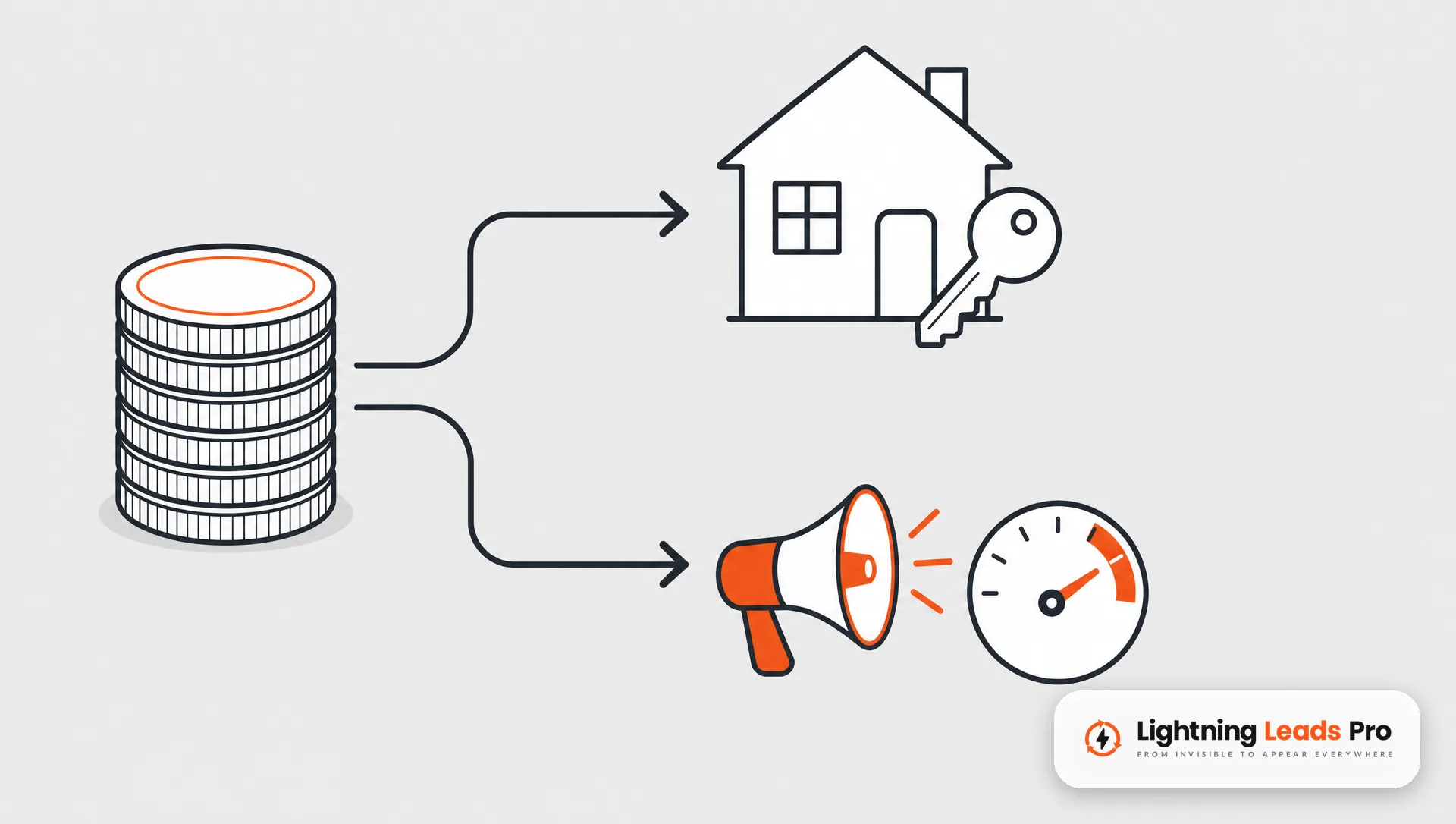
Think of your channels in two groups. Owned channels are the ones you keep working on and keep control of. Rented channels bring calls while you pay for them.
- Owned: your Google Business Profile, your website, your reviews, SEO and your past customer list.
- Rented: Google Ads, Local Services Ads, Facebook and Instagram ads, and shared lead sites.
“Owned” is a loose word, since Google hosts your profile. Google says creating a Business Profile is free, yet it still takes time or a paid partner to keep up. Our local SEO work covers your profile and reviews.
Rented channels work differently. With Local Services Ads, Google says you only pay when a customer gets in touch from your ad. Once the budget stops, that flow of calls stops too. We also manage Google and Meta ads as a paid ads add-on for our local SEO clients.
Our video walks through what Google and Facebook ads add while your local SEO keeps building.
Published splits disagree here too, and they use different buckets:
- BDR: 30 to 35 percent paid search and Local Services Ads. Then 25 to 30 local search and profile, and 15 to 20 website and content. It adds 10 to 15 for existing customers and 5 to 10 for reviews.
- Marketing 360: 30 percent high-intent search, 25 SEO and content, 20 database marketing, 15 brand and social, 10 testing.
- Cornerstone: 35 percent digital, 25 direct mail, 20 traditional media and brand, about 20 strategy and production.
- Hook Agency: at least half across SEO, pay-per-click ads and Local Services Ads.
We would not copy any of these line by line. Use them as a check, then apply a few plain rules:
- Fund owned channels first, and keep them steady. BDR notes that SEO and your profile take months to mature. Stopping and starting can waste that time.
- Use rented channels for a clear gap. Name the gap first, such as a new town or slow month.
- Lean more on rented channels when you are new. You may need calls while your profile and site build.
- Do not skip your past customers. Cornerstone’s webinar recap claims $8 to $12 back per dollar marketing to lapsed customers. New customers return $3 to $4, it says. That is one agency’s figure, so test it yourself.
Owned channels take patience, and they can pay off. Baez & Son Air Condition & Heating is one of our HVAC clients. By September, they were showing up in the top 3 on Google Maps for 4 of their 9 main searches. You can read more in our case studies.
Not sure where your budget should go first? Book a Free Local Lead Growth Session and we will look at where you show up today.
How to plan your budget around the seasons
HVAC demand follows the weather. ENERGY STAR’s maintenance checklist tells homeowners that contractors get busy once summer and winter come. It advises checking cooling in the spring and heating in the fall.
The advice on timing does not fully agree either. Cornerstone’s recap says to front-load 60 to 70 percent of spend into your peak four to six months. BDR repeats that, and also warns that a steady monthly budget beats a stop-and-start one.
You can honor both ideas by splitting your budget in two:
- A steady base. Your profile, website, reviews and SEO get about the same amount every month.
- A flexible layer. Ads rise before your busy months, and drop once the schedule is full or demand slows.
Google says you can edit your average daily budget at any time, so the flexible layer is easy to change. Use your own monthly job counts to set the timing. A cold state and a hot state may not peak in the same months.
How to judge your spend by cost per booked job
A percent tells you what to spend. It does not tell you if the money worked. The SBA’s advice fits here: compare your marketing costs to the revenue they generate.
Cost per booked job is the simplest way to do that. Add up everything you paid a source for the month, including fees. Then divide by the jobs it booked. Say a source cost $3,000 and booked 15 jobs. That is $200 per booked job. Those numbers only show the math and are not a target.
We compare each source in our guide to HVAC lead generation. For budget decisions, add these three habits:
- Separate repairs from replacements. A replacement job can carry a higher cost than a small repair. One blended number can hide that.
- Give owned channels more time. One slow month does not tell you much about work that takes months to build. Look at the trend.
- Review before you change the budget. Move money toward sources that book profitable jobs. Cut sources that only bring activity.
If your office does not record the source of each call, start there. Without it, any budget is a guess.

Frequently asked questions
How much should an HVAC company spend on marketing?
Published rules of thumb run from 5 to 15 percent of revenue. BDR says 5 to 10, Hook Agency says 7 to 10 and Marketing 360 says 10 to 15. Pick a start by stage, then test it against your capacity, margins and goal.
How much do businesses spend on marketing?
There is a wide range, as a guest post on the SBA’s older site puts it. That post cites a 7.9 percent average for 2018 and 11.8 percent for B2C services, from Web Strategies. Hook Agency notes some sources say most small businesses spend 2 to 5 percent of sales. HVAC guides often quote higher figures, and those guides mostly come from marketing companies.
Where should an HVAC company advertise?
A practical start is a Google Business Profile, a clear website and reviews. Then add Google Ads or Local Services Ads for specific gaps. The right mix depends on your market, so let cost per booked job decide.
How should I split my HVAC marketing budget across channels?
No single split fits everyone, and the published ones differ. Keep owned channels funded every month. Use a flexible ad budget for gaps and busy seasons. Include your past customers in the plan.
Should I cut my marketing budget when I am busy?
BDR warns against cutting when busy and scrambling when the phone goes quiet. If your schedule is full, a better first step can be lowering ad spend. Keep your steady base running, since that work takes months to build.
Set your 2027 number this month
You do not need a perfect percent. Pick a starting number from your stage, test it with your own math and write it down. Then split it into a steady base and a flexible layer, and review it by booked jobs each month.
Lightning Leads Pro is a veteran-owned, bilingual local SEO and AI search agency for HVAC companies. Want a second set of eyes on your plan? Book a Free Local Lead Growth Session and we will show you where you stand against the companies near you.