A good HVAC van wrap does one job. It tells a stranger who you are, what you fix and how to reach you. It has only a few seconds to do that.
So put your business name on it exactly as it reads on your Google Business Profile. Add one phone number, your website and a few words about your services. Make it big and high in contrast, and leave the rest off.
These steps work for one van, a small fleet or an HVAC truck wrap. A wrap is advertising, so judge it by the calls you can trace.
Key takeaways
- Use your business name exactly as it appears on your Google Business Profile.
- Show one phone number, one web address and a few words about your services.
- Big letters and strong contrast matter more than a clever design.
- Some states require your license number on work vehicles, so check with your state board before you print.
- Ask every new caller how they heard about you, so you can tell whether the wrap brings calls.
Step 1: Choose a full wrap, partial wrap or lettering
Start with how hard the van has to work. Your main ad on wheels may need more coverage than a van that only has to look professional. This table compares the three common options.
| Option | What it covers | Fits best when | Watch for |
|---|---|---|---|
| Full wrap | Sides, back, front and sometimes the roof | The van is your main ad, or the first in a growing fleet | Costs the most, since it takes more material and install time |
| Partial wrap | The most visible panels, usually sides and rear | You run one service vehicle and like its paint color | The design has to blend with the paint |
| Lettering or decals | Name, logo and contact details | You want a clean, professional van on a tight budget | Less room to catch the eye from far away |
Here are two published estimates. ServiceTitan wrote on May 19, 2025 that a typical van wrap costs $1,500 to $5,000. Van size and wrap type drive the price. Queen of Wraps, a wrap shop, wrote on Sept. 21, 2026 that its partial wraps start at $1,900. It also says decals and lettering cost less than either wrap.
These are estimates, not quotes. Get two or three written quotes for your exact vehicle.
Step 2: Put these six things on the wrap
Think of this as the whole list. If an item is not here, it has to earn its space.
- Your business name. Use the same words as your Google Business Profile, in the same order.
- What you do. Make the words heating, cooling or HVAC easy to see, even if your name already says it.
- One phone number. Use the number on your profile. Make it the largest item after your name.
- Your website. Use a short address that is easy to remember after one look.
- Services in a few words. Pick two or three that bring you calls, such as heating repair or AC replacement.
- Your license number. Add it where your state requires it. Step 5 covers this.
The name matters most, because customers may look you up later. Google’s guidelines ask you to represent your business the way it is known in the real world. That includes your signage and other branding. So decide on one name and use it everywhere.
A slogan can live on the van, but not in your profile name. Google’s name rules do not allow marketing taglines, phone numbers or added service details there. If a caller can really reach a Spanish speaker, a short “Se habla español” line can earn its space.
Step 3: HVAC van wrap ideas to leave off
ServiceTitan and Queen of Wraps both warn against clutter. Here is what we would leave off.
- Your full service list. Let your website carry the details.
- Extra contact details. Skip a second phone number, your email and a row of social media icons.
- Script or cursive fonts. They look nice up close and read poorly at speed.
- Stock photos. A photo of ductwork rarely tells anyone why they should call you. Low-quality images look worse.
- Prices and seasonal offers. A wrap stays on for years, and an offer does not.
- Claims you cannot back up. Words like “best” prove nothing, and some claims can break licensing rules.
That last point can catch owners by surprise. California’s contractor board says the law prevents contractors from advertising that they are bonded. State code ties this to the license bond or a disciplinary bond. It also requires you to name the type of insurance if you advertise “insured.” Check your own state’s rules before you add those words.
Step 4: Make the HVAC van wrap design readable at a distance
A design that looks sharp on a screen can fail on the road, so size your text for real distance. Queen of Wraps gives a rule of thumb: one inch of letter height per 10 feet of distance. By that rule, a number read from 50 feet needs letters about 5 inches tall.
Treat that as a minimum. For externally lit signs in Helvetica, the United States Sign Council’s standards list about 22 to 29 feet per inch. Queen of Wraps says to go larger for passing traffic.
Next, choose your colors for contrast. Dark letters on a light panel, or light letters on a dark one, read fast.
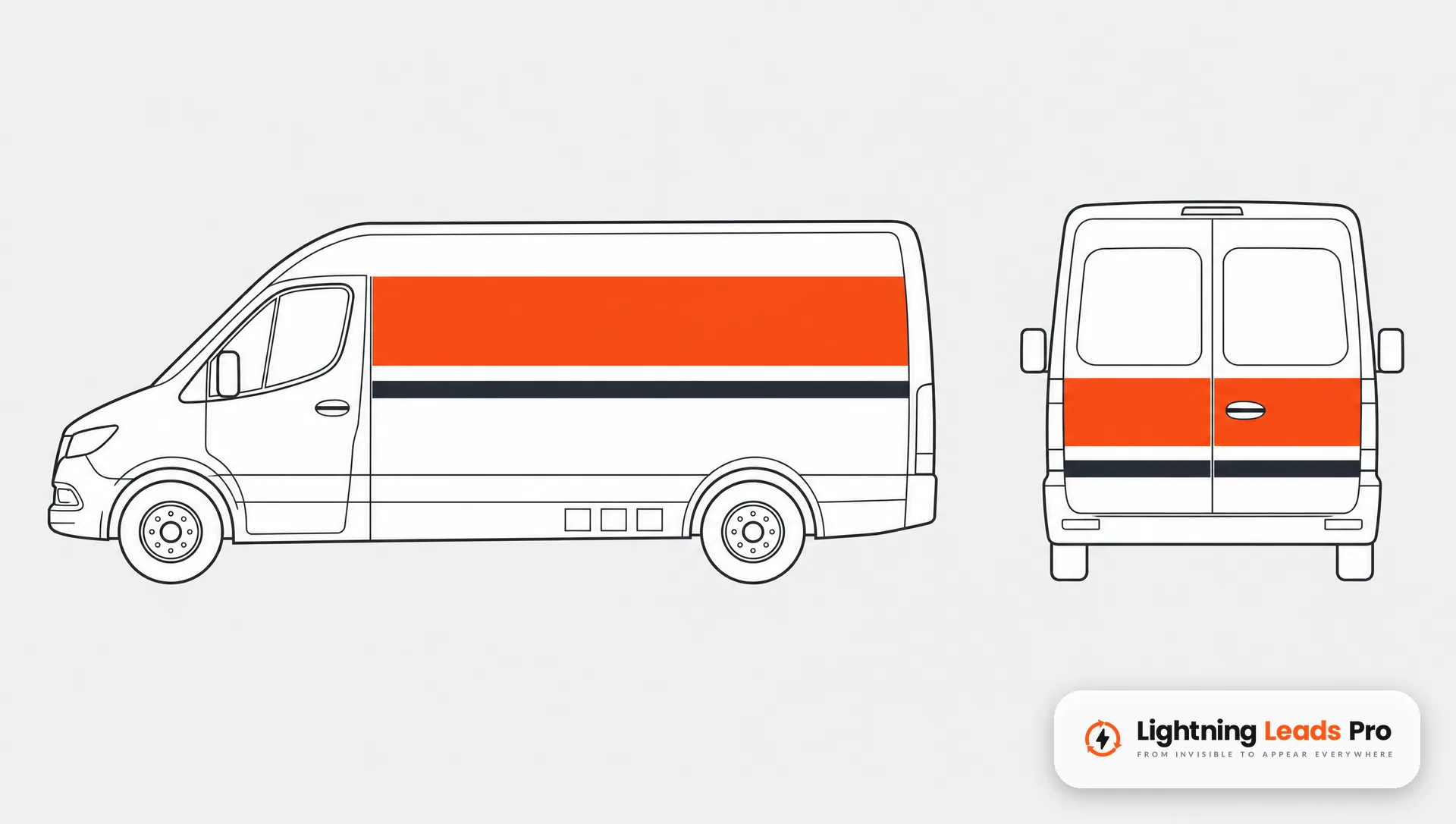
Queen of Wraps notes that drivers behind you see the back the longest. It says the sides matter most when the van is parked. Here is how we would use each panel:
- Sides. Carry your name, phone, website and services.
- Back doors. Keep to your name, phone number and one service line.
- Seams and hardware. Keep your name and phone number clear of door seams, handles, windows and the gas cap.
Step 5: Check the license rules in your state
Rules differ by state, and they can change. These three examples, as written at the time of this post, show how much they vary:
- South Carolina: Regulation 29-13 covers air conditioning and heating mechanical contractors. It calls for the license number on both sides of the vehicle. Letters must be at least 2 inches high on a contrasting background.
- California: The Contractors State License Board lists its vehicle rules by license type. Contractors outside plumbing, sign and well drilling must show their business name and license number on commercially registered vehicles. Use at least 72-point type, or letters at least 3/4 inch high and wide.
- Pennsylvania: The Attorney General’s office says a home improvement contractor’s vehicle ad must include the registration number.
Check with your state licensing board before you approve any design, and ask your attorney if the answer is unclear. Then give the shop the exact wording in writing.
Step 6: Connect the van to your online presence
Some people who see your van may look you up before they call. When they search Google, they should find the same business they saw on the van.
Match your name and phone number
Check that your van, your profile and your website all show the same name and phone number. Our guide to optimizing a Google Business Profile covers the profile side. If directories show old details, here is how to fix citations and NAP mismatches.
You may hear advice to use a separate tracking number. We would keep your main number, so every place shows the same one.
Use a memorable web address, and be careful with QR codes
A long address is hard to remember. Use your plain domain, and make sure the page works well on a phone.
A QR code only makes sense where someone can walk up to a parked van. If you add one, size it to scan from a few feet away. Test it before you print.
Ask callers how they heard about you
Add one question to your call script: “How did you hear about us?” Log “saw the van” as an answer in your job records. After a few months, you will have your own numbers.
You will see big impression numbers online for wraps. An impression is not a call.
Ask for reviews after the job
Someone who saw your van may read your reviews before calling. So ask every customer after the job, not only the happy ones. Google’s review tips say you can use a Google link or QR code for the request.
Google’s policy does not allow incentives for reviews or selectively asking for positive ones. It also says not to pressure customers while on the premises. Our guide on how to get more Google reviews covers the steps.
Not sure what a customer finds when they search your name? Book a Free Local Lead Growth Session and we will show you how you appear next to your competitors.

Step 7: Brief the wrap shop and check the proof
A clear brief saves rounds of changes. A careful proof check can stop a wrong number from going on your van.
What to give the shop
- The year, make, model, roof height and length of each vehicle, plus photos of every side.
- Your logo in the best file format you have, plus your brand colors.
- Every word that goes on the van, typed out exactly, including your license wording.
- A priority order: name first, phone second, then website and services.
Ask what each written quote includes: design rounds, the vinyl used, removal of old graphics and the warranty.
How to check the proof
- Compare your business name to your Google Business Profile, letter by letter.
- Read the phone number and web address out loud, then have someone else do the same.
- Ask for the height of the main letters in inches, and compare it to your distance target.
- Look at the design on your actual vehicle template, panel by panel, including seams and handles.
- Shrink the proof on your phone. If you cannot read the name and number, make them bigger.
- Check the license number against your state’s wording and size rule.
If you are wrapping a small fleet
Build one design before you wrap the second vehicle. Queen of Wraps suggests keeping colors, logo placement and phone number the same on every vehicle.
Frequently asked questions
How much does an HVAC van wrap cost?
It depends on the van, the coverage and the design. Step 1 lists two published estimates with their dates. Use them to plan, then get written quotes.
Should I get a full wrap or a partial wrap for one van?
A partial wrap can work well for one service vehicle. A full wrap makes more sense if that van is your main ad or the first in a growing fleet. If the budget is tight, clean lettering is better than a crowded wrap.
What size should the phone number be on a van wrap?
Decide how far away it needs to be read, then use the rule of thumb in Step 4. Ask the shop to state the height on the proof.
How long does a van wrap last?
Queen of Wraps and Wrapmate both estimate five to seven years. They list sun, install quality and washing among the factors, and both favor hand washing. Ask your shop what its warranty covers.
Will a van wrap help my Google rankings?
We do not claim that it will. Treat a wrap as advertising. Your Google Business Profile, website and reviews are separate work.
Make the van and Google say the same thing
Use the same name and number everywhere, keep the design simple and track where calls come from. We can help with the online side. Our local SEO work lists your business name, address and phone number the same way across the sites that matter. Our Google Business Profile management helps keep your profile accurate.
Want to see where your company stands before you print? Book a Free Local Lead Growth Session and we will walk through it with you.