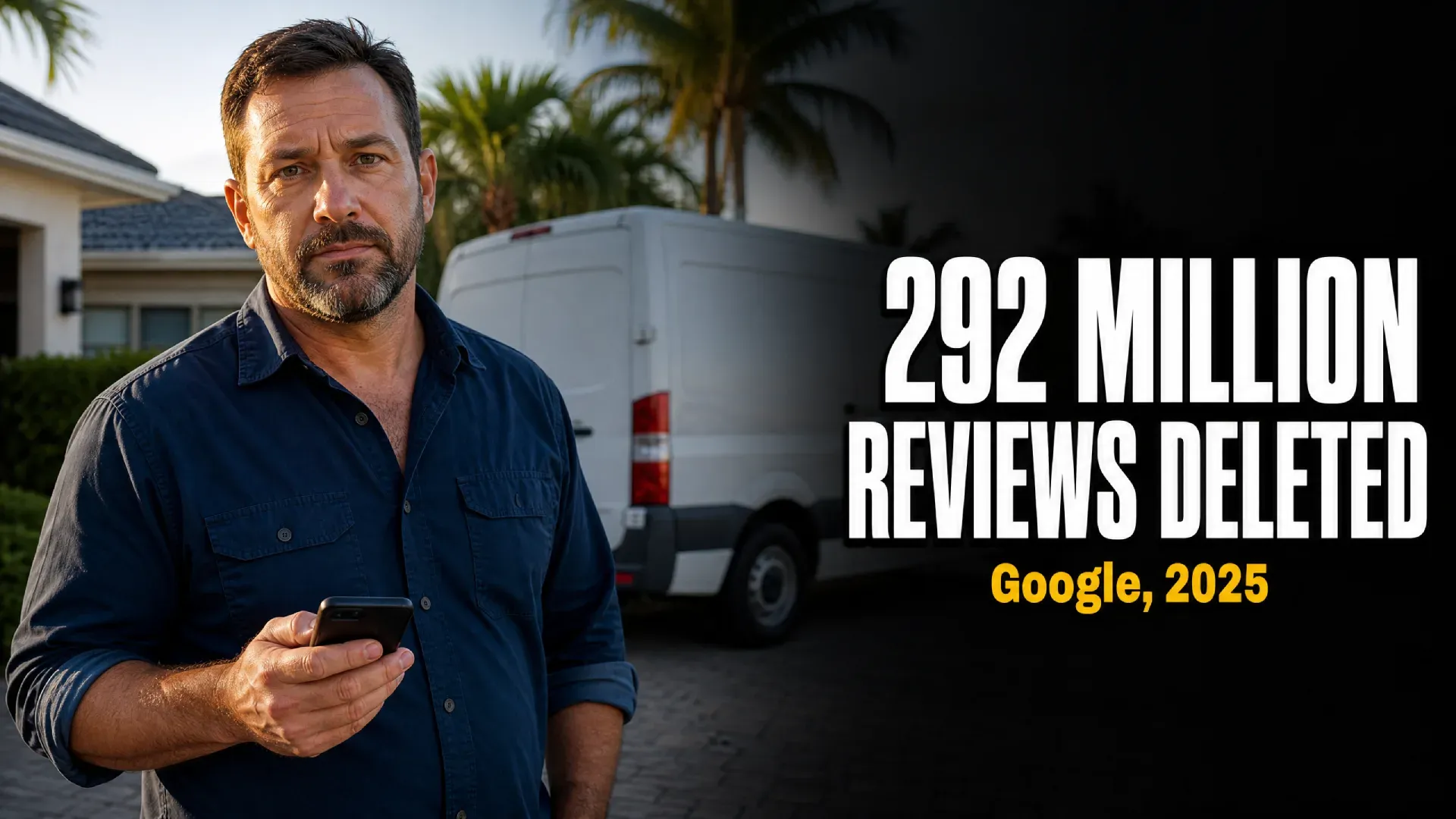
In 2025, Google blocked or removed more than 292 million policy-violating reviews and took down more than 13 million fake Business Profiles. Those are Google's own numbers, published on the Google blog, not an estimate from an agency.
Sit with that for a second, because it reframes the problem. Most contractors think they have a volume problem. A lot of them actually have a survival problem. They are earning them and then losing them, and the tactics they were taught by the last marketing company are the exact patterns Google's systems are built to catch.
This guide is the other version. How to ask in a way that produces real volume, why Google reviews vanish, and what to do when one does. Every rule below is quoted from Google's own documentation with the link.
What Google Reviews Actually Do for Your Ranking
Start with what Google publishes rather than what the local SEO industry repeats.
Google's local ranking page names three factors: relevance, distance, and prominence. Google reviews live inside prominence. Google's wording is direct: prominence is "based on info like how many websites link to your business and how many reviews you have," and "more reviews and positive ratings can help your business's local ranking."
Two things in that sentence matter.
It says how many, not how recent, and not how detailed. Google does not publish a freshness requirement, a keyword requirement, or a minimum length. If an SEO vendor tells you a review has to contain your service and your city to count, ask for the documentation. There is none.
It says help, not determine. Google reviews are one input inside one of three factors. A listing with 200 of them and the wrong primary category still loses to a listing with 40 and the right one. If your categories, service area, and business information are not sorted yet, fix those first. We walked through that in the guide to optimizing a Google Business Profile for home services.
With that said, Google reviews do a second job that has nothing to do with algorithms. They are the social proof a homeowner reads last, in the ten seconds before deciding which of the three map pack listings gets the call, and the only social proof on the page you did not write yourself. Ranking third with 180 reviews at 4.9 beats ranking first with 11.
Count Your Real Gap Before You Ask Anyone
Skip the industry benchmarks. Nobody can tell you the right number of Google reviews for a plumbing company in Brandon or an HVAC contractor in Riverview, because the right number is entirely local and you can measure it in about four minutes.
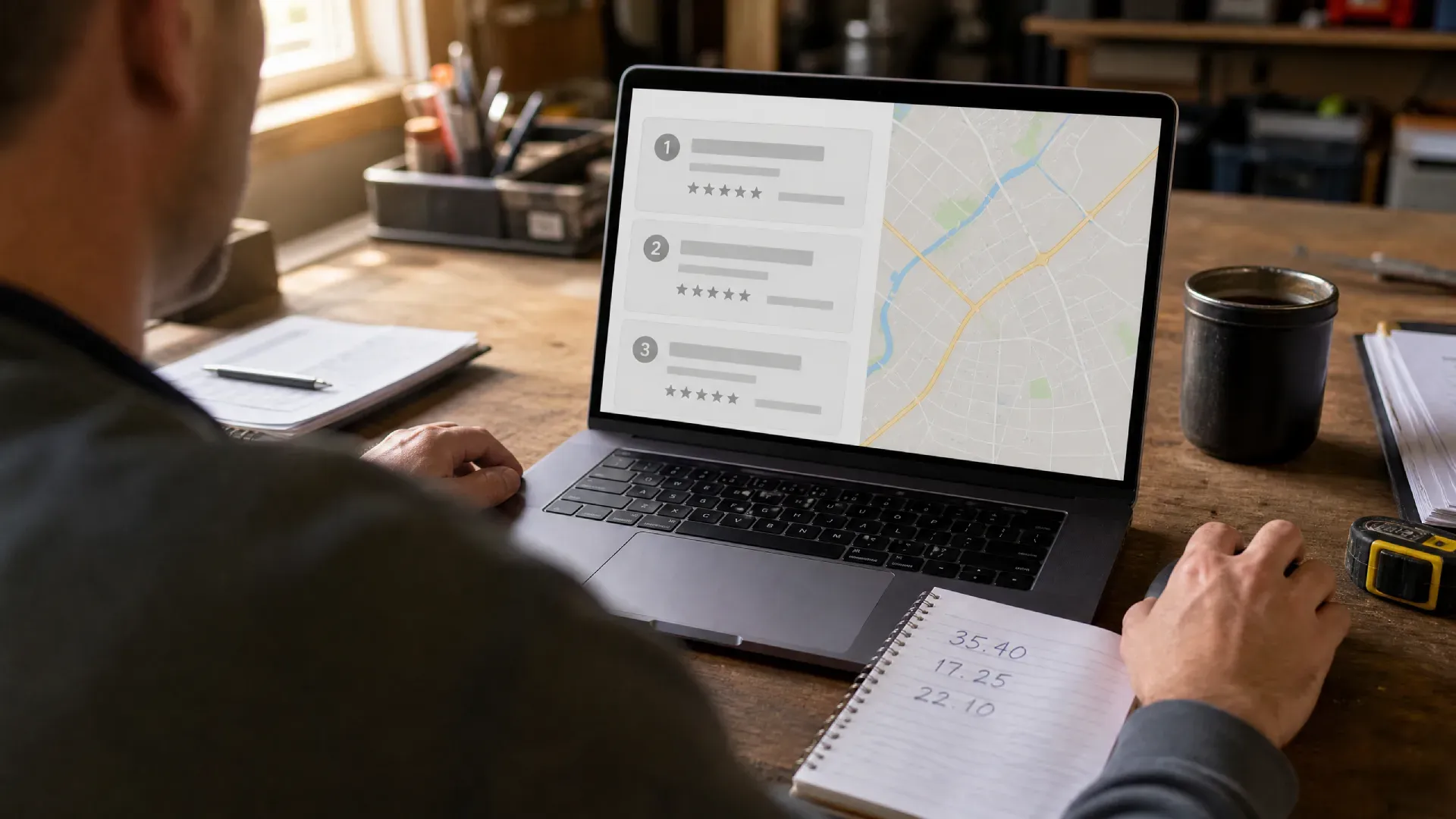
Open a private browser window. Search the term you actually want to win, the one a homeowner types when the heating quits on the coldest night of the year. Note the three businesses in the map pack and write down two numbers for each: total review count and star rating.
That is your target. Not a national average. The three specific companies standing between you and the phone call.
Now do the arithmetic that most contractors never do. If the leader has 240 Google reviews and you have 30, you need 210. If you close roughly 40 service and maintenance jobs a month and one in four customers leaves a review when asked properly, that is ten a month, so 210 takes 21 months. Lift the conversion rate to one in two and it takes about ten.
That number is the whole strategy. Everything below exists to raise the percentage of finished jobs that turn into a live Google review.
Ask Everyone, Every Job, Without Exception
Here is the single largest cause of low review counts in home services, and it is not laziness.
It is selection. The owner asks the customer who was thrilled. He skips the one who was fine, the one whose heating maintenance visit had to be rescheduled twice, and the one who questioned the invoice. That feels like judgment. It is actually the thing costing you most of your volume, because the merely satisfied customer is the majority of every job list, and it is also a policy violation.
Google's prohibited content policy says merchants may not "discourage or prohibit negative reviews, or selectively solicit positive reviews from customers." Filtering the list before you send is review gating, and it is banned by name.
The version that is explicitly allowed sits on Google's own tips page: "to leave reviews, you can ask customers to visit a Google link or scan a QR code." Ask everyone. Send the same message every time. Say nothing about what the review should contain.
Contractors resist this because they are afraid of what the unhappy customer will write. Two things about that fear. First, a customer angry enough to post one star will find your listing whether you sent a Google review request or not. Second, a profile with a hundred reviews at 4.7 converts better than a flawless 5.0 with twelve, because the flawless one reads as manufactured rather than earned. A handful of imperfect reviews with a good reply underneath is a trust asset, not a wound.
Build the Asking System
A Google review program is five decisions. Make them once, write them down, and stop improvising.
One: get the review link and put it everywhere it needs to be. Google gives every Google Business Profile a review link and a downloadable QR code from the dashboard. Put that review link into your invoice template, your job completion text, and your email signature. Print the QR code on the leave-behind. The number of taps between a finished job and a submitted review is the biggest lever you control, and a buried review link is why most programs stall.
Two: pick the moment and make it the same moment every time. The window is when relief is highest and the memory is fresh. For a plumbing call or a heating repair that is the same day, a few hours after the tech pulls out of the driveway, not while he is standing in the kitchen. Same day matters for a reason beyond psychology, which the next section covers.
Three: decide who asks. The tech in the home has the relationship. The office has the consistency. The strongest setup is both: the tech mentions that a follow-up message is coming, and the office sends the review link. What the tech must not do is hand over a phone or hover. Google's policy states merchants "should not require or pressure users to leave ratings or write reviews while on the premises."
Four: write the words once. See the next section.
Five: follow up exactly once. One reminder, two or three days later, then stop. A single polite nudge roughly doubles response in most service businesses. A third message reads as harassment and gets you nothing.
A Script That Does Not Script the Review
This is where the April 2026 policy change bites, and most review request templates in circulation are now non-compliant.
Google added two prohibitions under rating manipulation. Merchants may not request "that staff solicit a certain number of reviews," and may not request "reviews that include specific content, including content that identifies a staff member."
Read those again against what you are probably doing. The whiteboard in the shop tracking reviews per technician is out. The card that says "please mention Dave and the AC install" is out. So is any script that tells the customer what to write, which includes the very common template asking them to name the service and the city.
What is left is short, and it works better anyway.
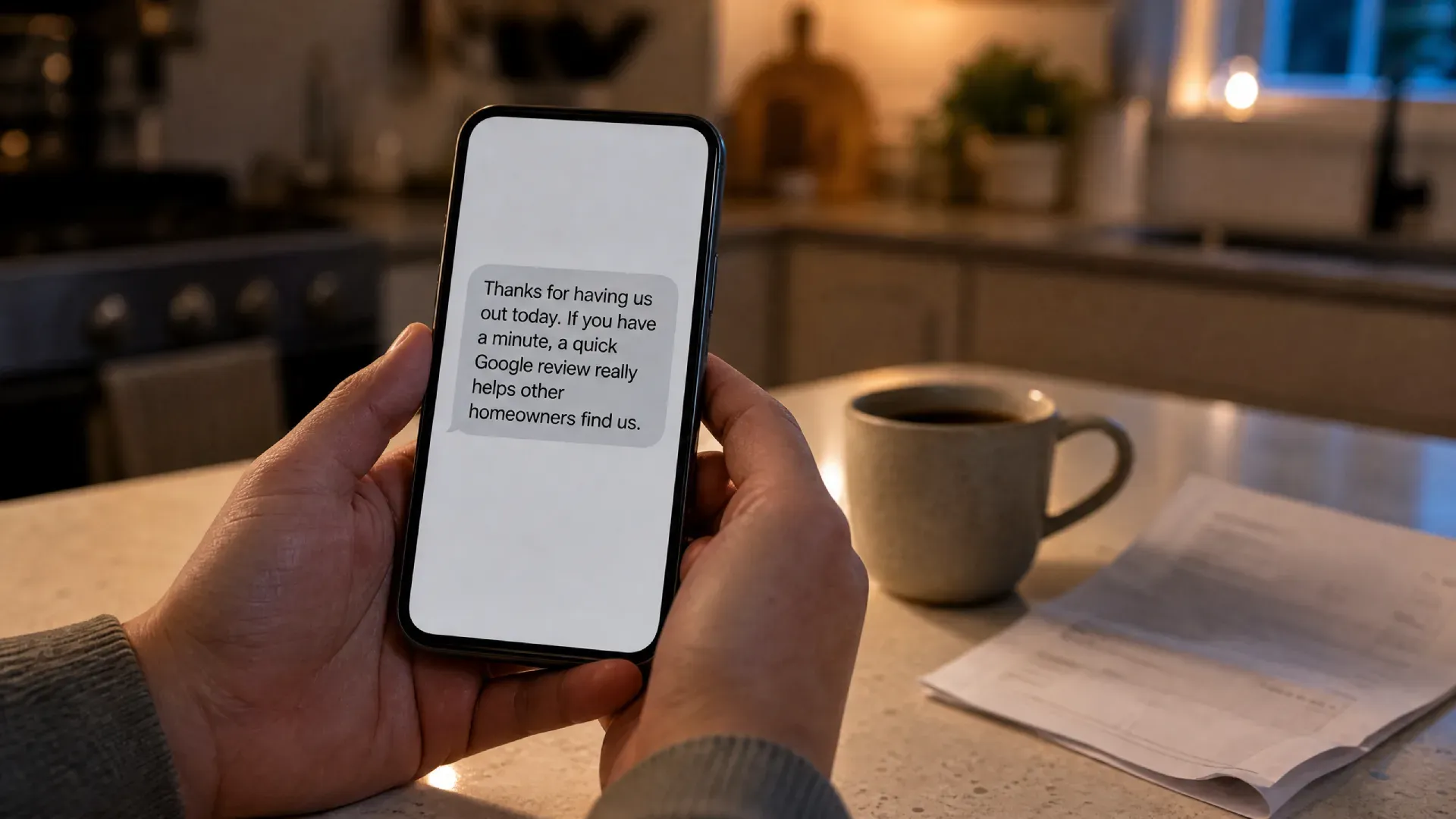
"Hi [first name], this is [your name] from [your company]. Thanks for having us out today. If you have a minute, a quick Google review really helps other homeowners in the neighborhood find us. Here is the link."
That is the whole thing. Greeting, thanks, one sentence of why, review link. No instructions about content, no star rating suggested, no mention of a staff member, no incentive of any kind. Offering "payment, discounts, free goods and/or services, in exchange for posting any review" is prohibited and Google treats it as fake and misleading content, which is the category most likely to get reviews removed in bulk.
The counterintuitive part is that stripping out the instructions raises quality. When you tell a customer what to say, you get stiff customer feedback that reads like every other line on the page and looks templated to both the reader and the filter. When you ask and get out of the way, you get the sentence about the tech who put booties on in the rain, which is the sentence that actually sells.
Why Your Google Reviews Disappear
If you have watched your count drop overnight, you are not imagining it and you are not alone. Practitioners across the local SEO industry tracked large-scale review deletions through 2025 and into 2026, with individual listings losing dozens at a time. Google has not published an explanation for any specific wave.
What Google has published is what its systems look for, and the pattern is consistent enough to plan around. Removals cluster where review activity looks coordinated rather than organic. In practice that means:
• Unusual volume arriving in a short window
• A batch that all comes from the same location, network, or device
• Reviewer accounts with no other review history
• Wording that repeats across multiple reviews
Now connect that list to the habits above. The contractor who saves up two weeks of jobs and texts everyone on Friday afternoon has produced a burst of reviews inside a few hours. The one who hands his own phone to customers has produced a run of reviews all submitted from the same device. The one who scripts the wording has produced a set of reviews that all say the same thing. Each of those is a legitimate business trying to be efficient, and each of them produces exactly the signature the filter is tuned for.
The defense is boring and effective. Ask continuously rather than in batches. Never let a review be submitted from your device or your network. Never supply the words.
One more thing worth knowing, because it works in your favor. Google now says that when a listing is targeted by review bombing, it will "quickly remove the fake content, pause new reviews on the profile, alert the Business Profile owner," and show a banner explaining the pause. It also says it now detects "attempts to demand payment in exchange for removing fake one-star reviews," which is a real extortion racket aimed at small contractors. If you get that message, do not pay. Report it.
When a Real Review Vanishes, and When a Fake One Stays
Two different problems, two different processes, and contractors constantly use the wrong one.
A genuine review disappeared. Check the Reviews Management Tool first, because the review may have been flagged rather than deleted. If it is gone and you believe it was legitimate, you can submit an appeal. Be realistic about the odds and do not build your month around the outcome. The better response is almost always to keep the flow of review requests going, because a steady stream of review requests absorbs losses that a one-time push never can.
A fake or abusive review is sitting on your profile. Report it. Google's process is four steps:
1. Open your profile and select Read reviews
2. Choose the report icon next to the review
3. Pick a reason, such as spam or profanity
4. Select Send report
Google says "review evaluation typically takes several days," and you can track the status in the Reviews Management Tool, where it will show as decision pending, reviewed with no policy violation found, or escalated.
Before you report anything, read this line from Google's documentation, because it decides most of these cases: "Do not report a review just because you disagree with it or dislike it. Google doesn't get involved in conflict between businesses and customers."
A one star review from a customer who genuinely thought your price was too high is not a policy violation. It stays. A review from a competitor who was never a customer, a review containing profanity or a personal attack on a technician, or a review posted by a former employee is a policy violation, and Google names conflict of interest specifically: content "based on a conflict of interest," including "current or former employment."
Replying Is Half the Job and Almost Nobody Does It
Google's guidance is that "when you reply to customer reviews, it shows that you value their feedback," and that "positive reviews and helpful replies can help your business stand out."
Reply to all of them. The five stars get one line, and it should not be copied and pasted, because a column of identical thank-yous is visible from the top of the page and tells a reader nobody is home.
The negative ones get a specific structure, and the audience is not the person who wrote it. It is the homeowner reading three months from now while deciding which of two professionals to call.
Acknowledge the specific thing that went wrong, in your own words, without restating the accusation. Say what changed because of it. Give a direct way to reach you. Keep it to three sentences and never argue, never mention what the customer owes you, and never hint that they are lying. A calm, specific reply under a two star review does more for the next reader than another line of praise above it, because it is the only place on the page where they get to see how the business behaves when something goes wrong. That is what online reputation is.
One caution on automation. Since June 2026, Gemini can draft review replies inside the profile, and it drafts well. Every draft still requires your approval, and it should get it, because the fastest way to make an online reputation look robotic is to let a machine post twelve replies in an afternoon.
Where a Tool Helps and Where It Does Not
No software makes people leave Google reviews. It makes the asking happen while you are on a roof.
That is the honest boundary. A review platform earns its money when it fires the review request automatically off a job completion in your field service software, staggers sends so you are not creating timing clusters, and alerts you the moment new customer feedback lands so the reply goes up the same day. It is not worth paying for as a source of review volume, and any SEO vendor selling it that way is selling you something Google's filter is designed to catch.
We compared the tools that actually do this, with confirmed pricing and the ones we would skip, in our guide to Google Business Profile management tools for contractors. If you would rather the asking, replying, and monitoring simply happen without you managing any of it, that is what our online reputation management service does for home service pros across Tampa Bay.

Frequently Asked Questions
How many Google reviews do I need to rank in the map pack?
Google publishes no threshold. More reviews and positive ratings can help local ranking, but the useful target is the review count of the three businesses currently in the map pack for your money term, not a national average.
Can I offer a discount or a gift card for a Google review?
No. Google prohibits offering "payment, discounts, free goods and/or services, in exchange for posting any review" and treats it as fake and misleading content.
Is it against the rules to only ask happy customers?
Yes. Google prohibits merchants from "selectively soliciting positive reviews from customers." Surveying first and sending the review link only to people who scored you well is review gating and is banned by name.
Can I ask a customer to mention the technician's name?
No. Since April 2026 Google prohibits merchants from requesting reviews that include specific content, "including content that identifies a staff member."
Can I set a review target for my technicians?
No. Google specifically prohibits merchants from requesting that staff solicit a certain number of reviews.
How long does Google take to remove a reported review?
Google says review evaluation typically takes several days, and you can check the status in the Reviews Management Tool.
Should I ask for the review while I am still at the house?
Send the review request by text or email after you leave. Google's policy says merchants should not require or pressure users to leave ratings or write reviews while on the premises, and reviews submitted from your device or network can look coordinated to Google's systems.
Do negative reviews hurt my ranking?
A small number of honest negative reviews with good replies underneath usually helps conversion, because a listing with no criticism at all reads as manufactured. What hurts is a low overall rating with no owner responses.
Where do I find my Google review link?
It is in your profile dashboard, alongside a downloadable QR code. Save the review link somewhere your office staff can reach it in one click, because a review link nobody can find is the most common reason a program stalls.
What do I do if someone demands money to remove one star reviews?
Do not pay, and report it. Google says it now detects attempts to demand payment in exchange for removing fake one-star reviews, and it pauses new reviews and alerts the owner when a listing is being review bombed.
See Where You Actually Stand
Google reviews are one of three or four things deciding whether you show up when a homeowner searches. Guessing which one is holding you back is expensive.
On a free Local Lead Growth Session we pull your real map position across your whole service area, compare your online reputation against the home service pros ranking above you, and tell you straight whether Google reviews are your bottleneck or something else is.
Book a Free Local Lead Growth Session
Veteran owned. One contractor per trade, per city. Backed by our 90-day guarantee.