Restoration Marketing Is Built on a Sentence the EPA Never Wrote
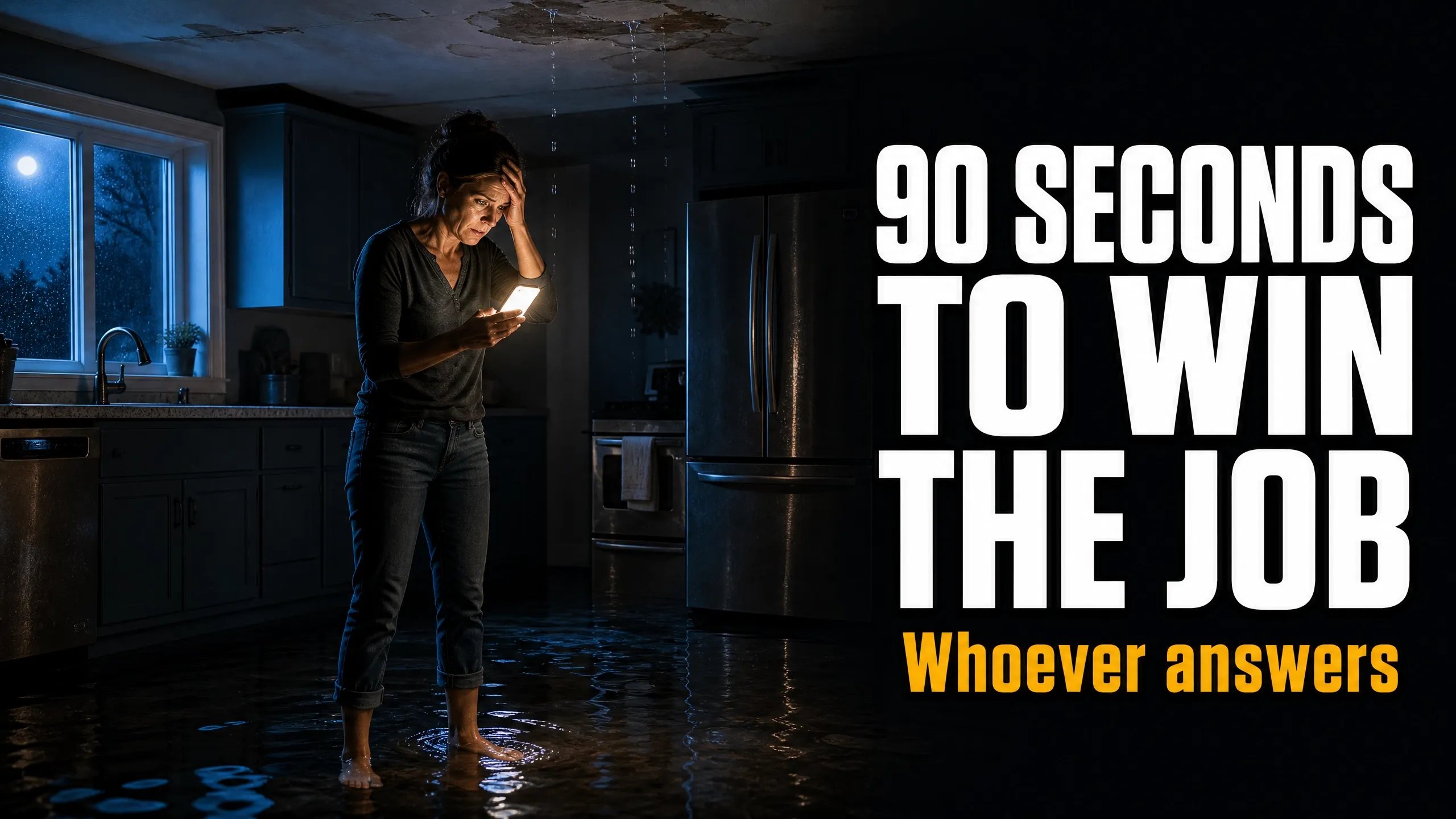
A pipe lets go in a second floor bathroom at 11:40 at night. By the time the homeowner finds the shutoff, water is coming through the kitchen ceiling and standing on the floor.
Here is what that person does next, and it is worth being honest about it. They do not read your About page. They do not compare your certifications against the company down the road. They pick up a phone that is already in their hand, type something close to "water damage repair near me," and start calling from the top. Whoever picks up and says they can be there tonight gets the job.
That is the entire buying process. It takes about ninety seconds.
Almost all restoration marketing is built for a customer who does not exist: someone calmly researching mitigation providers on a Tuesday afternoon. This article is about the customer who does exist, and about one specific piece of copy that nearly every restoration company in the country has on its website which does nothing at all. Water damage restoration marketing is the sharpest version of the problem, because the emergency is real and the window is short, but the same logic runs through fire, mold and storm work.
The Sentence on Almost Every Restoration Website
Open five water damage restoration websites in your market. You will find a version of this sentence on at least four of them:
"Mold can begin growing within 24 to 48 hours of water exposure."
It is the load bearing sentence of the trade. It sits on home pages, service pages, truck wraps and paid ads. It is the reason the phone is supposed to ring right now instead of tomorrow.
There are two problems with it. The first is commercial and obvious: if four of your five competitors open with the identical claim, it is not persuasion, it is wallpaper. Nothing that appears on every website in a market can differentiate any of them.
The second problem is that it is not what the federal agencies actually say.
What the EPA Actually Says
The Environmental Protection Agency does publish a 24 to 48 hour figure. It is worth reading the exact construction, because it is not a claim about mold starting to grow.
From the EPA's A Brief Guide to Mold, Moisture and Your Home:
"It is important to dry water-damaged areas and items within 24-48 hours to prevent mold growth."
And in the same guide:
"If wet or damp materials or areas are dried 24-48 hours after a leak or spill happens, in most cases mold will not grow."
Read that second sentence carefully. It is a statement about drying succeeding, hedged with "in most cases." It sets a deadline for your work. It does not say what happens on the other side of the deadline.
The EPA does address that, in Mold Remediation in Schools and Commercial Buildings, and what it says cuts in both directions at once. In the notes to its water damage response table, the agency writes:
"Even if materials are dried within 48 hours, mold growth may have occurred."
And then, in the same passage:
"Note that mold growth will not always occur after 48 hours; this is only a guideline."
That page was last updated on September 25, 2025. It is current federal guidance, and it says the 48 hour mark is a guideline that fails in both directions. Mold can already be there at hour thirty. It can also fail to appear at hour seventy.
The Centers for Disease Control uses the same framing the EPA does. Its guidance says to "clean and dry or remove wet items within 24-48 hours to prevent mold from growing." A drying deadline, again. We could not find any CDC page that states a growth onset time.
Where the Popular Version Came From
The growth phrasing does exist in federal material. It appears in a FEMA consumer brochure, Dealing With Mold and Mildew In Your Flood Damaged Home, which says:
"Mold growths, or colonies, can start to grow on a damp surface within 24 to 48 hours."
That brochure carries no date. It is the only federal document we could locate that states onset rather than a drying deadline, and it is a consumer handout rather than a technical standard.
So the industry's most repeated sentence traces back to an undated brochure, while the agency everyone names in the citation is publishing an explicit warning that the number is only a guideline.
We are not telling you to stop conveying urgency. The urgency is real. Standing water damages a building continuously and a homeowner who waits three days has a materially worse outcome than one who calls at midnight. We are telling you that the specific sentence you are using to convey it is borrowed, unexamined, identical to your competitors', and weaker than the truth.
The stronger version is the one you can actually stand behind: federal guidance sets a 24 to 48 hour window to get the structure dry, the agency that publishes it warns that mold may already have started inside that window, and nobody can tell a homeowner over the phone which case they are in. That is a better argument than the one everyone else is making, and it has the advantage of being accurate.
What Actually Happens in the First Ninety Seconds
Now to the part that generates calls.
For a trade where the buying decision takes ninety seconds and happens on a phone, marketing collapses into three questions. Do you appear? Can they reach you? Are you open?
Do you appear. The homeowner sees a map pack with three businesses in it and a sponsored listing or two. If you are not in that block, you are not in the consideration set. There is no scenario where a person with water on the floor scrolls to position eight. This is why the map pack is not one channel among several for restoration companies. For emergency queries it is close to the whole channel, and it is the reason we treat ranking in the map pack as the first job for any emergency trade.
Can they reach you. This has changed, and it has changed against you. Action buttons on organic map pack listings are not the reliable fixture they were two years ago. We have watched mobile results where the organic listings carried no Call button while a sponsored listing directly beneath them carried three. If the button is not there, the homeowner has to tap into your profile and then find the number, and every extra tap is a chance they call the next name instead. Ranking first is worth less when the first result is harder to act on than the paid one underneath it.
Are you open. A profile showing closed hours at midnight is invisible to the exact search that matters most to your business. This is the cheapest fix in restoration marketing and a surprising number of companies have it wrong.
Setting Up a Profile for a Trade That Works at 2 AM
Google's own documentation is specific here, and getting this configuration right is worth more to a restoration company than a quarter of blog posts. It is also the bulk of what Google Business Profile management actually consists of for an emergency trade.
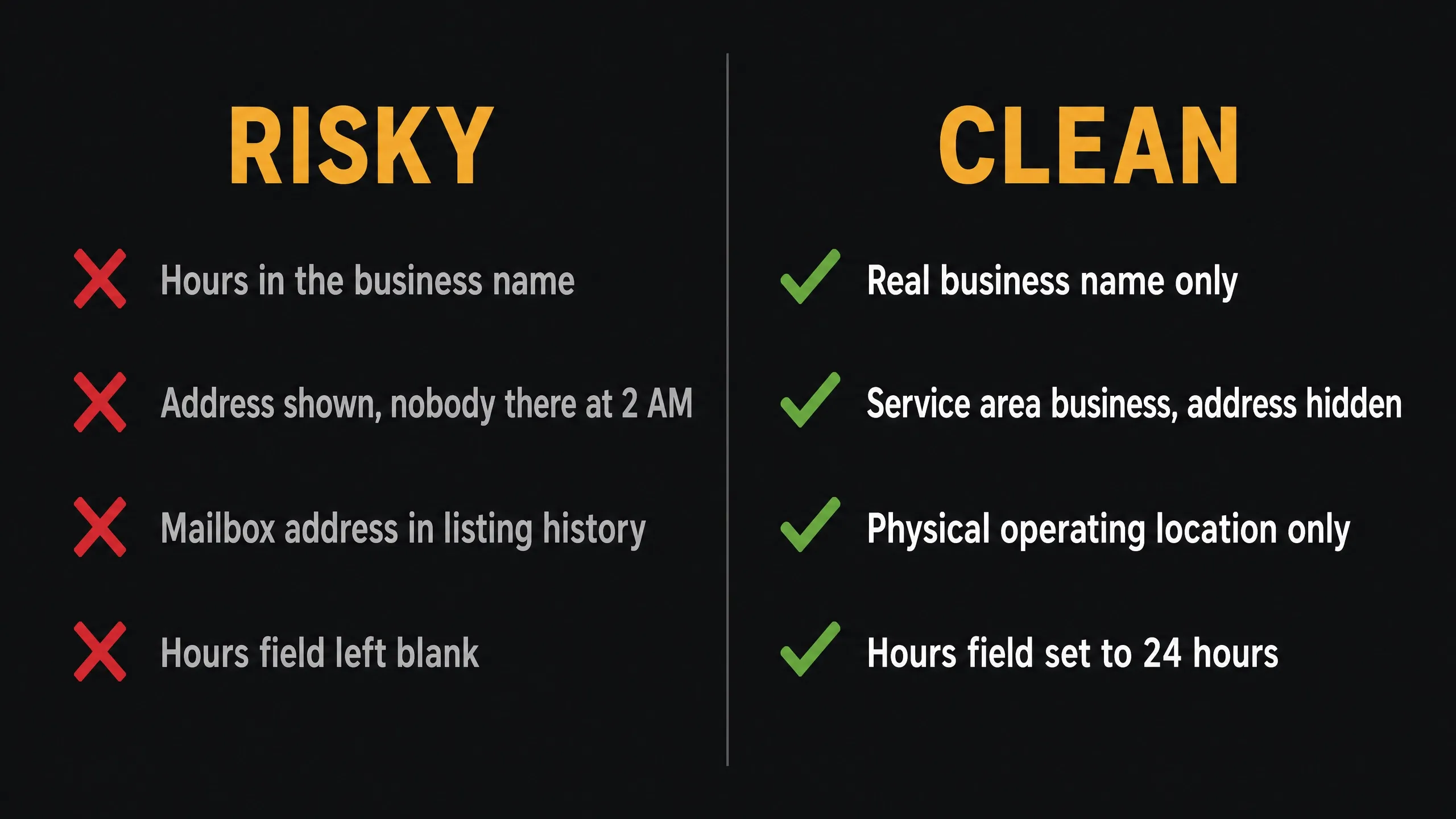
Set 24 hour hours in the hours field. Google supports it directly. Its instructions read: "Each day of the week that your business is open, click Opens at and then 24 hours and then Save."
Do not put availability in your business name. This trips up restoration companies constantly, because "ABC Restoration 24/7 Emergency Water Removal" feels like free advertising. Google's business name guidelines list a not acceptable example that is almost exactly this pattern: "Regal Pizzeria Open 24 hours," corrected to "Regal Pizzeria." The guidelines state that your name "should reflect your business's real-world name," and that "Including unnecessary information in your business name isn't permitted, and could result in the suspension of your Business Profile." Hours belong in the hours field. Putting them in the name risks the entire profile, which for an emergency trade is the whole business.
Configure as a service-area business and hide the address. Google's guidance is that "Service-area businesses, or businesses that serve customers at their locations, should have one profile for the central office or location with a designated service area," and that "If you're a service-area business, you should hide your business address from customers." You can set up to 20 service areas, and Google advises that the overall boundary "shouldn't be more than about 2 hours of driving time from where your business is based."
There is a tension worth understanding. Google also requires that a business displaying an address be "staffed by your team and able to receive customers during its stated hours." A restoration company that sets 24 hour hours and displays a physical address is asserting a staffed location that receives customers at three in the morning. We have not found a Google page that spells out this interaction, so treat it as our reading rather than a Google statement, but the clean configuration for this trade is service-area, address hidden, 24 hour hours.
One more thing Google is explicit about: "P.O. boxes or mailboxes located at remote locations aren't acceptable," and a rented mailing address the business does not operate from "isn't eligible for a Business Profile." Restoration companies that started from a truck and a home office sometimes have a mailbox address in their listing history. That is a suspension waiting to happen, and it is the same class of problem as a citation and NAP inconsistency that quietly holds a profile down.
The Statistics Restoration Marketers Cite That Do Not Hold Up
If you have been pitched by a marketing company in this space, you have heard some version of these. They are worth examining, because a pitch built on them is a pitch built on nothing.
"76 percent of people who search for something nearby visit a business within a day." This one is real, and it is Google's. It is also from a study dated May 2016, it is ten years old, and it measures physical visits to a business. Restoration customers do not drive to your office. They call. Using a store visit statistic as a proxy for emergency phone calls is a category error, and it circulates constantly in home services marketing.
"80 percent of local searches are on mobile." The real figure is narrower than the claim. Google published that 80 percent of "near me" searches came from mobile in the fourth quarter of 2014. That is a specific query type in a specific quarter twelve years ago, not a general statement about local search.
"Customers call three companies before choosing one." We went looking for a credible source for this and could not find one. Every result was a call tracking vendor, a lead generation company, or a statistics aggregator, and several of them cite each other in a loop. No neutral researcher appears to publish this number. We would rather tell you it does not exist than repeat it.
There is one piece of Google research in this area that is genuinely useful and almost nobody cites it. Comparing the first halves of 2015 and 2017, Google found that "search volume for local places without the qualifier 'near me' has actually outgrown comparable searches that do include 'near me'," with those searches growing 150 percent. People stopped typing "near me" because they expected Google to already know where they were. A restoration company being sold heavy optimization for literal "near me" phrases is being sold a pattern that Google itself described as reversing nine years ago.
TPA Work Is Not Marketing
Most restoration companies eventually face the question of whether to sign up with a third party administrator. A TPA is a company contracted by an insurance carrier to administer claims on the carrier's behalf, as the trade publication Restoration and Remediation describes it, "in an effort to reduce overall claim cost, personnel costs, and decrease cycle times." The TPA is not the carrier. It is a vendor to the carrier.
This is a legitimate way to fill a schedule and it is not marketing. It is a different business model with different economics, and it is worth being clear-eyed about the trade.
The same trade publication documents what enrollment typically requires: a minimum number of years in operation, specified insurance coverage with additional insureds named, and in many programs no home-based businesses. Service level agreements can require a contractor to "make contact with a homeowner in less than two hours" and to "upload preliminary estimates through Xactanalysis in less than 24 hours." Contractors also generally agree that they "may only be able to charge Xactimate or Symbility prices." The Restoration Industry Association, which advocates for restorers, has written that "Restorers, especially with smaller companies, are often the victims of unequal bargaining power in the settlement of restoration claims."
Here is why this belongs in an article about marketing. The homeowner is usually free to choose you directly, and in several states that freedom is written into law.
Louisiana's statute is the most explicit we found. It states that an insurer "shall not require that repairs, replacement, restoration, or remediation be made to an insured's property by a particular preferred vendor or recommended contractor," and that an insurer may not recommend one "without informing the insured or claimant that the insured or claimant is under no obligation to use the preferred vendor." California's Fair Claims Settlement Practices Regulations provide that "No insurer shall require that the insured have the property repaired by a specific individual or entity." New York's Department of Financial Services has stated that "absent a clause in the insurance policy, a property/casualty insurer or any of its agents may not mandate that an insured under a homeowner's policy use a specific contractor for repair and restoration."
We verified those three. We did not run a fifty state survey and we are not claiming one. Many state anti-steering statutes cover automobiles only rather than property, Texas being an example. Check your own state, and check it with a lawyer rather than with a marketing article.
The point stands regardless of the statute in your state. A direct call from a homeowner who found you first is worth more than the same job routed through a program that sets your pricing and takes a fee. Marketing is the thing that produces the first kind of job. Every direct call you generate is a job you own the margin on.
The Review Problem Nobody in This Trade Talks About
Restoration has a review problem that other trades do not.
A satisfied HVAC customer is a person whose house is comfortable again. A satisfied restoration customer is a person who had the worst week of their year and would rather forget it happened. Asking them to write publicly about it feels intrusive in a way that asking a remodeling client does not. So restoration companies ask less often, and their profiles carry fewer reviews than their job volume should produce.
That gap is expensive, because reviews are one of the strongest levers on map pack position, and map pack position is close to the entire channel for this trade.
The fix is timing and framing rather than volume of asks. The right moment is not the day the equipment comes out, when the customer is still living with the damage. It is after the space is back to normal, when what they remember is that someone showed up at midnight and it worked out. The ask should reference the specific thing you did, not the abstract experience. The same principles that apply to getting more reviews for any home service business apply here, with more care about when.
The Market Is Getting More Crowded, Not Less
Some context on the competitive picture. IBISWorld puts the US damage restoration services market at $7.7 billion in 2026, grown 2.4 percent that year. That figure covers all damage restoration, water, fire, mold and storm, not water alone.
The number that matters more is the count of firms. IBISWorld reports 57,615 damage restoration businesses in the US as of 2026, up 3.5 percent from 2025.
Firms are entering the market faster than the market is growing. That is a compression, and it shows up as more names in the map pack for the same searches and more competition for the same insurance work. Both figures come from a commercial research firm behind a paywall rather than from a government source, so treat them as directional.
What to Do, in Order
If you run a restoration company and you want more direct emergency calls, the sequence is not complicated.
First, fix the profile. Hours set to 24 hours. Availability language out of the business name. Service-area configuration with the address hidden if you do not receive customers. Service areas set within a realistic drive. No mailbox addresses anywhere in your listing history. This costs nothing and it is the difference between existing and not existing at midnight.
Second, get the map pack position. For emergency queries this is the channel. Reviews, categories, proximity, and a profile that is complete and active. This is slower work and it is the work that compounds.
Third, fix the copy. Replace the borrowed mold sentence with the accurate version. You will be the only company in your market making an argument that a homeowner cannot find verbatim on four other websites.
Fourth, build the review engine. Ask at the right moment, ask specifically, and ask every time.
Fifth, decide about TPAs deliberately. Not as a default and not as a rescue when the schedule is thin, but as a decision about what share of your capacity you are willing to run at someone else's pricing.
Frequently Asked Questions
Does mold really grow in 24 to 48 hours?
Federal guidance is more careful than the industry's version of it. The EPA sets 24 to 48 hours as the window to dry water-damaged materials in order to prevent mold, and states plainly that "mold growth will not always occur after 48 hours; this is only a guideline." It also warns that "Even if materials are dried within 48 hours, mold growth may have occurred." The honest position is that the window is a drying deadline, not a growth clock.
Should I put "24/7 Emergency Service" in my Google Business Profile name?
No. Google's guidelines prohibit adding hours or service information to the business name and state that doing so "could result in the suspension of your Business Profile." Set 24 hour hours in the hours field instead. It accomplishes the same thing without risking the profile.
Should a restoration company hide its address on its Business Profile?
If you do not receive customers at your address, yes. Google's guidance is that service-area businesses should hide the address. Displaying an address commits you to a location that is staffed and able to receive customers during your stated hours, which is a difficult commitment to keep if your stated hours are 24 hours a day.
Are TPA programs worth joining?
They fill a schedule, and they do it at pricing you do not set, with response time requirements and enrollment conditions that many smaller firms cannot meet. They are a capacity decision rather than a marketing strategy. The higher margin work is the direct call, which is what marketing produces.
How long does local SEO take for a restoration company?
Profile corrections can affect visibility within days. Map pack movement in a competitive market is typically a matter of months, not weeks, and it depends heavily on review velocity and how established the incumbents are. Any company promising a specific position on a specific date is guessing.
Where This Leaves You
Restoration marketing has an unusual property: the customer's decision is fast, emotional, and made almost entirely on what they can see and reach in the first minute. That makes most of what gets sold as restoration marketing beside the point, and it makes a small number of unglamorous things decisive.
Fix the profile so you exist at midnight. Earn the map pack position so you are in the three. Replace the borrowed mold sentence with the accurate one so your page says something no competitor's page says. Ask for reviews at the moment the customer remembers you well. None of that is exotic and most restoration companies in any given market have not done it.
We work with one contractor per trade, per city. When a restoration company claims its city with us, we close that trade to their competitors there, because the map pack has three slots and we are not going to sell the same three slots twice.
On a free Local Lead Growth Session we run a real grid scan across your service area, pull your actual profile performance including calls rather than just views, and show you what a homeowner sees when they search your trade in your city at two in the morning. Then we tell you straight which of those is costing you work. If you would rather read first, our water damage restoration marketing page covers how the program works.
We back our work. If you follow our recommendations and we do not produce measurable improvements within 90 days, we keep working at no charge until we do. Measurable means real movement: rankings improving, more calls coming in, heatmap positions turning green. This is a partnership. You hold up your end, we hold up ours.
Book a Free Local Lead Growth Session
Veteran owned. One contractor per trade, per city. Backed by our 90-day guarantee.