
A homeowner's AC dies on a 95 degree Tampa afternoon. Five years ago, they Googled "AC repair near me," scanned the map pack, and called whoever had the best reviews and a fast-sounding name. Today, a growing share of them ask ChatGPT or Perplexity the same question instead, and they call whichever two or three companies the answer names, without ever loading a search results page.
That shift in behavior is where the phrase "AI SEO" came from, and it is also where the confusion started. Every agency is selling it now. A lot of them are just relabeling the same rank-tracking retainer they sold last year and hoping nobody asks what changed.
Here is the honest answer, without the hype: traditional local SEO and AI SEO share a lot of the same foundation, but they are not the same discipline. They optimize for different outcomes, they get measured differently, and the work that wins each one is not identical. Both matter. Neither replaces the other yet.
Key Takeaways
• Traditional local SEO and AI SEO share a foundation (accurate business data, real content, review signals), but they optimize for different endpoints: ranking position versus being the answer an AI names.
• Google itself says there is no separate technical process to appear in AI Overviews, but independent research shows AI tools like ChatGPT and Perplexity often cite sources that never rank in Google's top 10 for the same question, so the overlap is real but far from total.
• Measurement differs. Traditional SEO tracks keyword rank and map pack position. AI visibility is tracked by whether and how often a business gets named inside an AI-generated answer, a newer and less standardized kind of monitoring.
• This is a young, fast-moving field. Nobody, including the AI platforms themselves, has it fully figured out, so treat anyone selling guaranteed AI rankings with the same skepticism you'd apply to guaranteed Google rankings.
What Traditional Local SEO Actually Optimizes For
Traditional local SEO has a two-decade playbook, and it still works. The target is a position: a spot in the Google Maps pack, a ranking on page one for "[service] near me," a listing that shows up when someone in your service area searches with intent to book.
The levers are well understood. Your Google Business Profile category, completeness, and proximity to the searcher. Consistent name, address, and phone data across directories. Review volume and recency. On-page content that matches search intent. Backlinks from relevant local and industry sites. BrightLocal's research on local ranking factors confirms what most local SEOs already assume: GBP category and proximity carry enormous weight, and a complete profile measurably changes whether someone visits or calls.
This is the system that gets a contractor found on a normal Google search. It has been the whole game for years. It is not going away, and any AI SEO effort that ignores it is building on sand.
What AI SEO (Answer Engine Optimization) Actually Optimizes For
AI SEO, sometimes called answer engine optimization, targets a different outcome entirely: being named inside a generated answer. Not a link on a results page, the actual sentence a tool like ChatGPT, Perplexity, or Google's own AI Overview writes when someone asks "who's a good HVAC company in Tampa" or "best plumber near me that does emergency calls."
To get named, an AI model has to find your business, understand what you do and where you operate, and trust the source enough to repeat it. That favors clear, fact-dense content: specific service areas stated in plain language, direct answers to common questions, structured data that spells out what you do and where, and third-party mentions (reviews, directories, local press) that reinforce the same facts. Vague homepage copy written for humans skimming, not for a model trying to extract facts, tends to get skipped over.
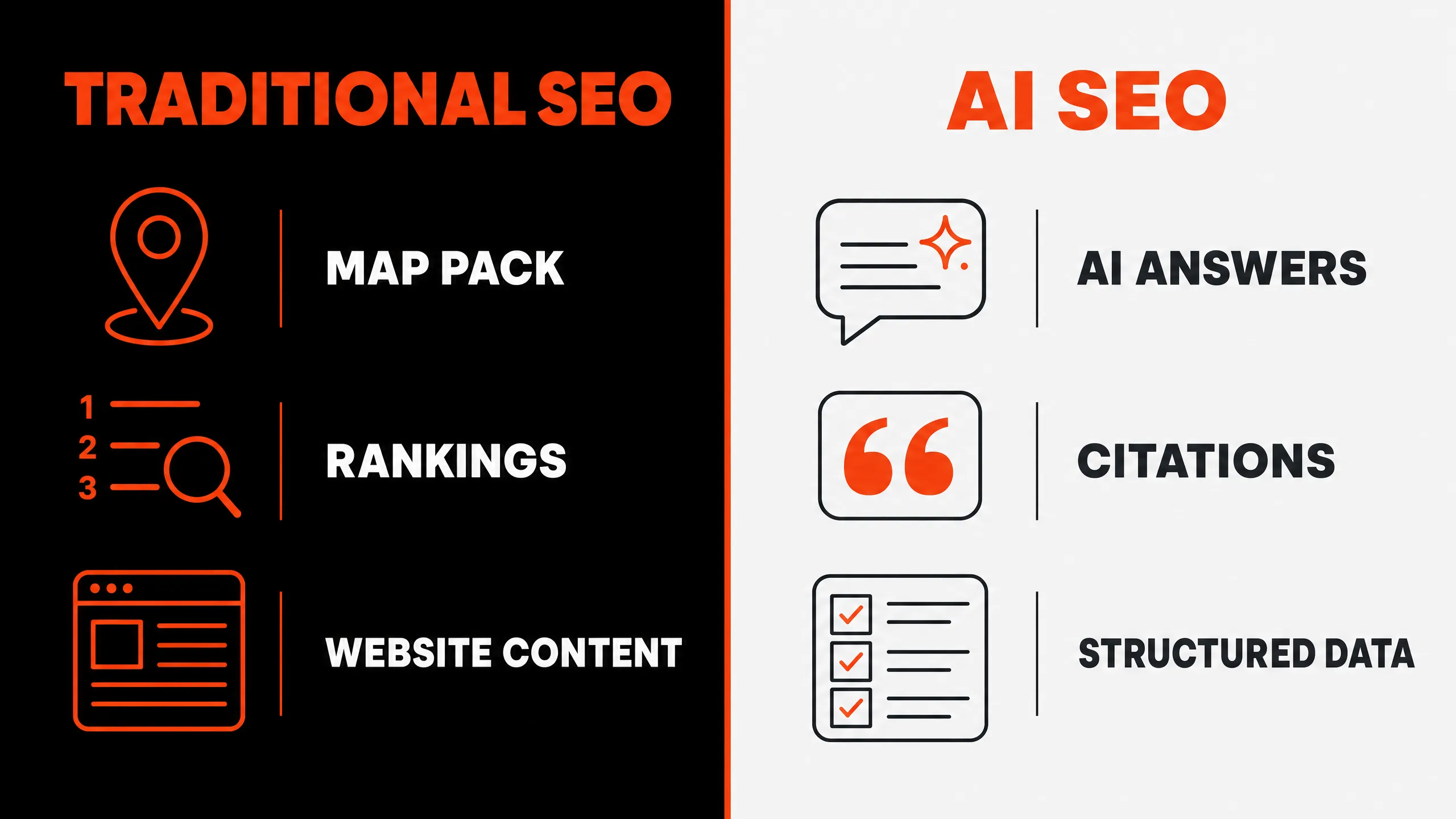
Where the Two Overlap, and Where They Actually Diverge
The overlap is bigger than the hype suggests. Google's own guidance on AI features is blunt about it: "There are no additional requirements to appear in AI Overviews or AI Mode, nor other special optimizations necessary." Google's AI features pull from the same crawlable, well-structured, genuinely useful content that ranks in regular search. If your site is a mess for Google, it is a mess for Google's AI too.
But Google's own AI features are not the whole AI SEO picture, and this is where "it's basically the same thing" stops being true. Ahrefs analyzed 15,000 long-tail prompts across ChatGPT, Gemini, and Copilot, and found that only 12 percent of the URLs those tools cited also ranked in Google's top 10 for the same question. Roughly 80 percent of AI citations did not rank anywhere in Google's top 100. Perplexity was the exception, with closer to a third of its citations overlapping Google's top 10, likely because it was built specifically to prioritize sourcing. The takeaway: different AI tools pull from different signals, and a page that ranks well on Google is not automatically the page an AI assistant will choose to cite.
Practically, that means: keep doing the traditional local SEO work, because it is still the foundation and it is what Google's own AI features draw from. Then layer in content built to be extracted and cited on its own, clear facts, specific answers, structured formatting, because the broader AI answer ecosystem does not run on Google's rules alone.
How We Measure Each, and a Real Result
Traditional SEO gets measured the way it always has: rank tracking, map pack position, organic traffic in Google Search Console. That instrument still matters and it is not optional.
AI visibility needs a different instrument, because there is no "position one" to screenshot. It means checking, on a regular basis, whether specific AI tools name your business when asked realistic questions a homeowner would actually type or say out loud. It is younger and less standardized than rank tracking, and we tell clients that plainly rather than pretending it is a solved science.
We can point to a real result here instead of a promise. One of our clients was recommended by ChatGPT, Perplexity, and Gemini simultaneously for the same type of question, three separate AI systems naming the same business without coordinating with each other. That is the kind of outcome AI SEO work is aiming for, and it is measurable, even if the discipline behind it is still young. It is part of what we build inside our Appear Everywhere Framework, which treats visibility as one connected system across Google, AI answers, and everywhere else a homeowner might be looking, rather than as separate projects competing for budget.
One more thing worth being honest about: speed still decides who gets the job once you are visible, in AI answers or anywhere else. A homeowner who gets named three companies is calling or messaging whichever one responds first. That is why AI follow-up, an AI assistant that replies in seconds, answers real questions, qualifies the lead, and books the job, matters as much as the visibility work that got you named in the first place. Visibility without a fast response behind it is a wasted mention.
Key Differences and Strategic Takeaways
We are a veteran-owned SEO agency, and we work with one contractor per trade, per city. When an HVAC company claims their city with us, HVAC closes to their competitors there.
We back the work with a 90-day conditional guarantee. We define measurable progress upfront. If we do not deliver it, we keep working at no charge until we do. No ranking promises, because no one controls Google. Accountable, measurable progress instead.
Frequently Asked Questions
Is AI SEO just a rebrand of regular SEO?
Not entirely. The foundation overlaps heavily, crawlable sites, accurate business data, real content still matter for both. But AI SEO targets being cited inside a generated answer rather than ranking on a results page, and research shows that outcome does not always track with traditional Google rankings, especially outside Google's own AI features.
Do we need to choose between traditional SEO and AI SEO?
No, and choosing would be a mistake either way. Traditional local SEO is still what gets a home service business found on a normal Google search, and it is also the foundation Google's own AI features pull from. AI SEO is an added layer on top, not a replacement.
How do you measure whether AI SEO is working?
By checking, on an ongoing basis, whether AI tools like ChatGPT, Perplexity, and Gemini name your business when asked realistic questions a homeowner would ask. It is a newer kind of monitoring than rank tracking, and less standardized, so treat early numbers as directional rather than final.
Should a home service business trust an agency that guarantees AI rankings?
Be cautious. This is a genuinely new field, even Google describes its own AI features as running on the same fundamentals as regular search, not a separate optimization track. Anyone promising guaranteed placement inside AI answers is promising something nobody, including the platforms themselves, fully controls.
The Real Answer Is Both, Done Honestly
AI SEO is not a buzzword you can ignore, and it is not a wholesale replacement for the local SEO work that still gets contractors found on Google. It is a related, overlapping, still-evolving discipline that rewards the same honesty this whole field needs more of: build a business that is genuinely easy to find, easy to understand, and fast to respond, and both the map pack and the AI answers have a reason to point to you.
If you want a straight read on where your business stands in both channels right now, Book a Free Local Lead Growth Session and we will show you the actual data instead of a sales pitch.