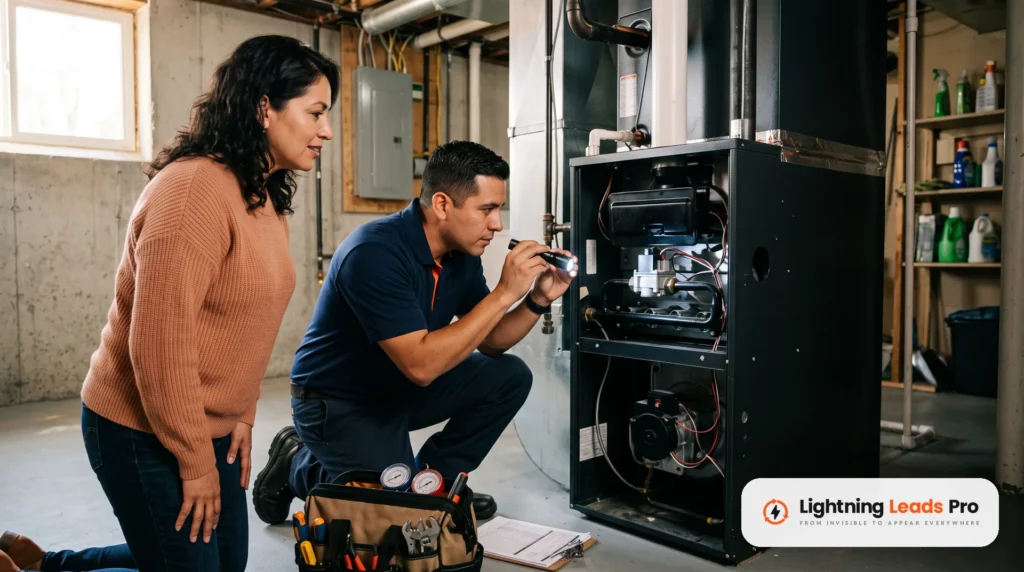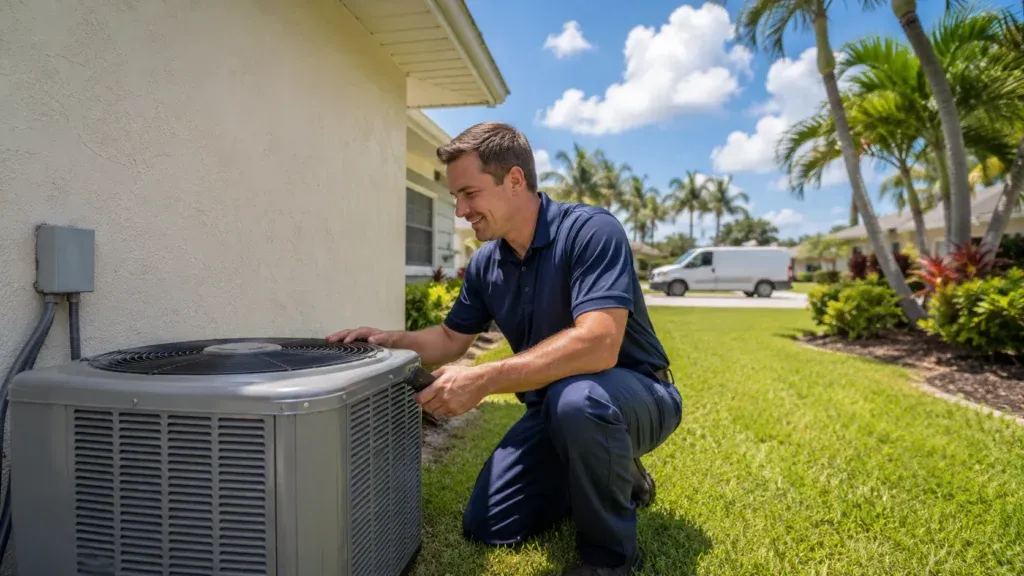
It is 2 p.m. in July and a Tampa homeowner’s AC just quit. They grab their phone and search “AC repair near me.” They call one of the first companies they trust. That call is a booked job worth thousands. Was that company you, or your competitor?
Local SEO decides the answer. It is the work of getting your HVAC company found the moment a homeowner searches for AC repair, heating, or installation near them. It covers your Google Business Profile (formerly known as Google My Business), your reviews, your website, and the local signals Google trusts. Done right, you show up first on Google Maps, in search results, and in AI answers.
This guide walks through every part of that work. Use it as a checklist or a roadmap. Start with the section closest to the problem you are trying to fix.
Key Takeaways
• A complete Google Business Profile is the single biggest driver of map pack rankings for Tampa HVAC companies.
• Fresh reviews build trust with homeowners and lift your local rankings at the same time.
• City and service pages help you rank across your full service area, not just one zip code.
• Matching name, address, and phone listings across the web confirm your business is real.
• A fast, mobile-friendly site turns more searches into booked calls during a summer rush.
• AI search and automated follow-up are now part of local SEO, not a separate project.
• Tracking your numbers tells you what is working so you can spend on what pays.
What Local SEO Means for a Tampa HVAC Company
Local SEO is how you rank for searches tied to a place. Think “HVAC service Tampa” or “AC repair near me.” When homeowners search those terms, Google shows local results first. Your job is to own that space.
There are three places you need to win. The map pack at the top of Google. The organic links below it. And AI search, where tools like ChatGPT and Google AI Overviews now answer questions directly. A strong plan gets your HVAC company into all three, so the call comes to you instead of a competitor.
Why HVAC SEO Is Different From Regular SEO
HVAC search does not behave like other industries. Get these four differences right and you pull ahead of most HVAC contractors in your market.
Demand spikes with the weather. It does not climb in a steady line. In Tampa, cooling searches surge every summer, roughly April through October. Your pages need to rank before the heat hits, not after.
The buyer is in a panic, not a comparison. When the AC dies, the homeowner calls the first company they trust. A slow page or a buried phone number hands the job to someone else.
Your territory is many cities, not one. Most HVAC companies serve five to ten cities from one shop. That takes a dedicated page for each city you cover. One page cannot rank everywhere.
The map often beats the website. For HVAC, a top map pack spot is worth more than the number-one link. You earn it through your Google Business Profile, reviews, and local citations.
Google Business Profile: Your Most Important Asset
Your Google Business Profile is the single biggest signal for local rank. It decides whether you land in the map pack, the three map results at the top of local searches. For an HVAC company, that profile is often the first thing a homeowner sees and the biggest source of calls.
Fill out every field with accurate details. Your legal business name, address, and phone number must match your website exactly. Set your real service areas and hours. Pick a primary category that fits your main service, like “HVAC contractor” or “Air conditioning repair service.” Add photos of your trucks, your team, and real jobs.
Then keep it active. Post seasonal updates and promotions. Add fresh photos after jobs. Add the questions homeowners ask, with clear answers, to the FAQ on your service pages. An active profile tells Google your business is open and busy, which helps you rank. Our Google Business Profile management service handles this end to end. For the full playbook, see our guide on GBP optimization for Tampa HVAC companies.
How does a Google Business Profile help my Tampa HVAC ranking?
It tells Google where you work and what you do. A complete, active profile shows up more often on Search and Maps. It also lets a homeowner call you in one tap. More visibility plus less friction means more booked jobs.
What are the key steps to set up and manage a GBP?
Start with a complete profile and pick the right primary category. Verify your listing so Google trusts it. Add every service you offer with a short, clear description. Post updates and photos on a regular schedule. Respond to every review and question. Check the profile each month and adjust as your services change.
Winning the Map Pack
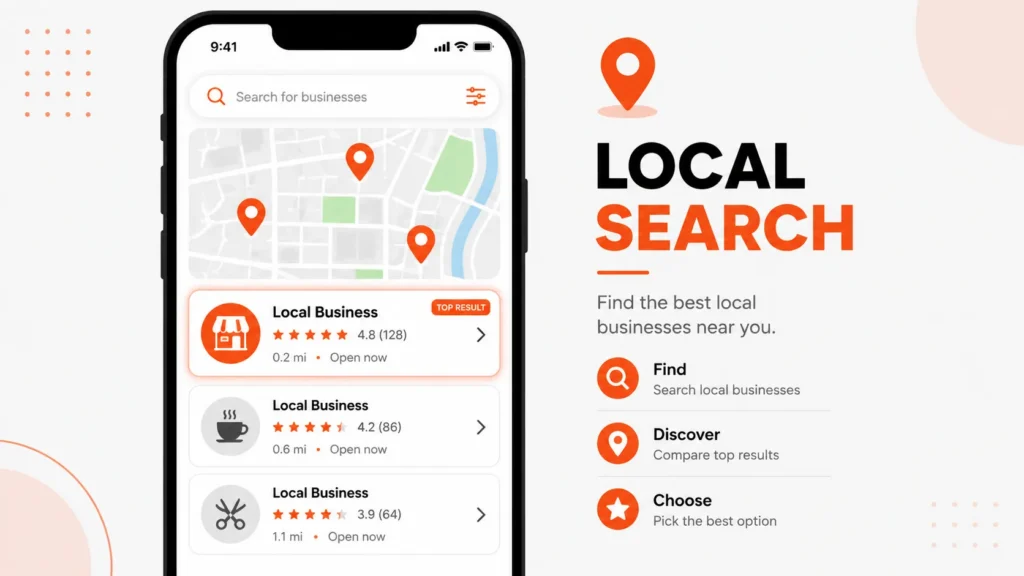
The map pack is the block of three businesses at the top of local search, right under the map. For HVAC, it is the most valuable spot on Google. Most clicks and calls go to those three companies.
Three things drive your map pack rank. A dialed-in Google Business Profile. A steady flow of real reviews. And matching local citations across the web. Stack all three and you compete for the top three. We break the signals down in how to win the Google local pack.
We do this work for home service companies across Tampa Bay. You can see the before-and-after map results on our case studies page.
How long does it take a Tampa HVAC company to rank in the map pack?
It depends on your competition and how consistent you are. An established company that cleans up its profile, fixes its citations, and starts collecting reviews can see movement in two to three months. A brand-new company in a busy market can take six months or more. Anyone promising instant rankings is guessing.
Why isn't my HVAC company showing up on Google Maps?
Usually it comes down to a few common gaps. Your profile is missing info or set to the wrong category. Your name, address, and phone number do not match across the web. You have fewer reviews than the companies above you. Or your reviews stopped coming in a year ago. We cover the fixes in why your AC repair business isn’t showing up on Google Maps.
Reviews: Proof That Sells and Ranks

Reviews do two jobs at once. They push you up the local rankings, and they convince homeowners to call you instead of the next company. Most people read reviews before they ever pick up the phone.
Build a simple system. Ask every happy customer for a review right after the job is done. Send a text with a direct link so it takes ten seconds. Respond to every review, good or bad. When you fix a problem in public, you show the next homeowner that you stand behind your work. Our reputation management service automates the ask so reviews keep coming.
How many reviews does an HVAC company need to rank?
There is no magic number, and it changes by market. What matters more than the total is the pace. A steady flow of fifteen to twenty reviews a month beats two hundred reviews dumped in one week. Google rewards recent, real reviews. Keep them coming and you stay competitive.
Do customer reviews really affect local rankings?
Yes. Reviews are one of the top signals Google uses to rank local businesses. Recent reviews with good ratings help you rank higher and win more calls. A calm, professional reply to each one adds even more trust with future customers.
Localized Content: Pages Built for Your Service Area
Google ranks individual pages, not whole websites. A single homepage that lists every service and every city tells Google nothing clearly, so it ranks for almost nothing. Content is how you prove you are the local expert.
Build a dedicated service page for each thing you do. AC repair, AC installation, heating repair, and maintenance plans. Build a separate page for each city you serve, from South Tampa to Riverview to Brandon. Then add helpful articles that answer real questions, like “why is my AC not cooling in July.” Seasonal content works well here, such as tune-up tips before summer. Learn more on our local SEO page.
What content should a Tampa HVAC company publish?
Publish the pages that match how homeowners search. One page per service, one page per city, and articles that answer the questions you hear on every call. Cover seasonal needs, common repairs, and buying decisions. Write in plain language and always give the reader a next step.
Local Citations: Confirming Your Business Is Real
A citation is any place online that lists your business name, address, and phone number. Google reads these listings to confirm you are real and where you work. When your details match everywhere, you build trust. When they clash, your rank suffers.
Get listed on the directories homeowners and search engines actually use. Yelp, the Better Business Bureau, Angi, and your local chamber of commerce are strong starting points. Keep every listing accurate. If you move or change your number, update all of them. Community sponsorships and local partnerships earn extra citations and links that lift your standing.
Which local directories should HVAC companies prioritize?
Focus on the trusted, high-traffic ones first. Google, Yelp, the Better Business Bureau, Angi, and local chamber listings carry weight for HVAC. Add your city and industry directories after that. The goal is the same name, address, and phone number on every one.
Mobile and Speed: Where Calls Are Won or Lost
Most HVAC searches happen on a phone, often from a homeowner whose AC just quit. That moment is high stakes. A slow page or a buried phone number hands the job to a competitor in seconds.
Keep three things tight. A mobile layout that is easy to read and tap. Fast load times, because every extra second costs you clicks. And a click-to-call button above the fold on every page. Add simple contact forms that take seconds to fill out. Clean technical SEO behind the scenes helps Google crawl and rank your pages. Our website design service builds all of this in from day one.
Does mobile optimization really affect HVAC leads?
Yes, and it is one of the biggest factors. A homeowner with a dead AC will not fight a slow, clunky page. They tap back and call the next company. A fast, simple mobile site keeps that call yours.
AI Search and Automation: The New Front Door
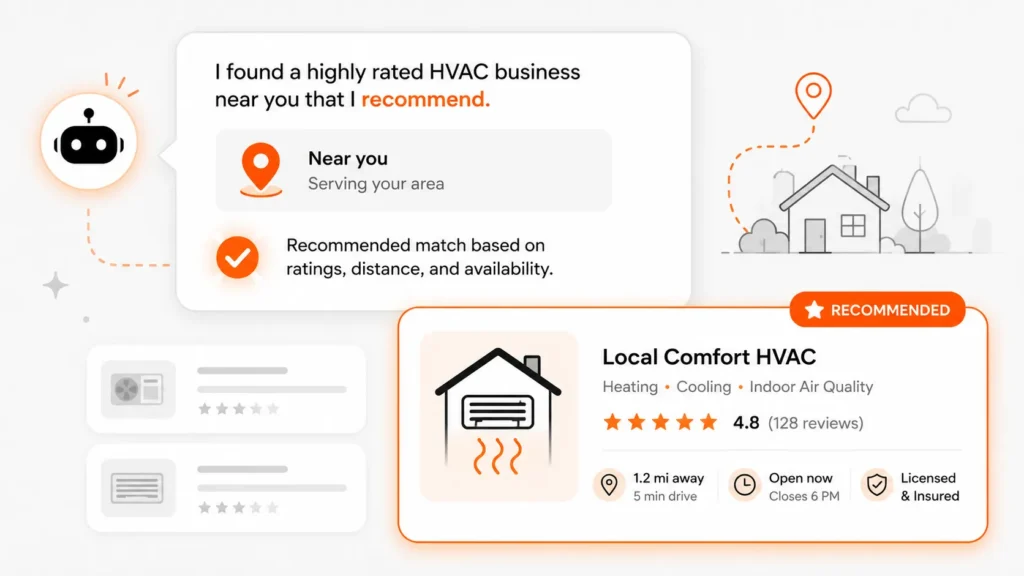
Homeowners no longer search only on Google. Many now ask ChatGPT, Gemini, or Perplexity for a recommendation. Google itself shows AI Overviews at the top of many searches. If those tools do not mention you, you are invisible to a growing group of buyers.
Getting cited by AI is its own skill, sometimes called answer engine optimization. It rewards clear answers, structured content, and a strong, consistent presence across the web. The same work that builds local trust also helps AI tools find and recommend you. We have gotten clients recommended by ChatGPT, Perplexity, and Gemini, and you can see it on our case studies page. Our AI search and AEO service is built for this shift.
Automation handles the other half. An AI chat agent captures leads through text and chat instantly, day or night. Automated follow-up sends a text to every new lead within seconds and keeps nudging until they reply. Speed to lead is one of the highest-return moves an HVAC company can make, and most never set it up.
How is AI search, also known as AEO and GEO, changing HVAC SEO?
It adds a new place you need to show up. Buyers ask AI tools for the best HVAC company in their area, and those tools pull from your content, reviews, and citations. HVAC companies that write clear, helpful pages and keep their profiles strong get named. The ones with thin, outdated sites get skipped.
Track Your Results and Spend on What Works
You cannot improve what you do not measure. Set up Google Search Console and Google Analytics so you can see what your local SEO is doing. Watch impressions, clicks, and the searches you show up for.
Then tie it back to the number that counts. Not clicks, but booked jobs and revenue. Track calls, form fills, and where they came from. Review the data each quarter. Update pages that underperform, double down on the ones that win, and refine your keywords as demand shifts with the seasons. A quarterly content audit keeps the whole system healthy.
Putting It All Together
Local SEO is not one trick. It is a set of moving parts that work together: a dialed-in Google Business Profile, fresh reviews, pages built for your service area, matching citations, a fast mobile site, AI visibility, and steady tracking. Each part supports the others. Skip one and the rest work harder for less.
Most owners do not have time to run all of this while also running trucks. That is the work we handle for HVAC companies across Tampa Bay. See how our Tampa HVAC SEO program pulls these pieces into one system built to book more jobs.
We also back it. If you follow our recommendations and we do not produce measurable improvements within 90 days, we keep working at no charge until we do. Measurable means real movement: rankings climbing, more calls coming in, map positions turning green. This is a partnership. You hold up your end, we hold up ours.
Frequently Asked Questions
How much does local SEO cost for an HVAC company in Tampa?
It depends on your market, your competition, and how much ground you need to cover. The better question is return. A single booked HVAC job can cover a month of SEO, and local SEO builds an asset you own instead of leads you rent. We give you a clear number on a free Local Lead Growth Session.
Is local SEO better than buying shared leads?
For most HVAC companies, yes. Shared leads go to several companies at once and keep you competing on price. Local SEO earns you calls that are yours alone, and the rankings keep working after you stop paying for a lead. See the full comparison in local SEO vs. HomeAdvisor for Tampa HVAC companies.
How long does local SEO take to work for a Tampa HVAC company?
It is a build, not a switch. Many HVAC companies see early movement in the first 60 to 90 days, like better map rankings and more calls. The larger gains grow over time as your authority and reviews build. This is why we tie our work to real, measurable progress.
Do I need a separate page for each city I serve?
Yes. One page cannot rank well for every city. A dedicated, well-written page for each service area is how you capture the searches spread across your whole territory.
Will local SEO help my HVAC business show up in AI answers like ChatGPT?
Yes. Homeowners now ask AI tools who the best AC company near them is. The same foundation that ranks you on Google helps these tools find and name your business: a strong profile, clear content, real reviews, and consistent data.
How can AI tools help my HVAC business convert more leads?
AI chat and automated follow-up answer new leads in seconds, qualify them, and help book the job. They cut response time, which is often the biggest reason HVAC companies lose work they already paid to attract.
Ready to Get Found in Tampa Bay?
You can keep guessing at this one piece at a time, or you can have an HVAC SEO agency build the whole system for you. We help Tampa Bay HVAC companies with their online presence. We help them rank on Google Maps, in search, and in AI answers, then turn those searches into booked jobs.
Book a Free Local Lead Growth Session and we will show you exactly where you stand and where the biggest wins are. Book your session here