Start with the fact that changes the math on all of this.
Sterling Sky tracked AI local packs across 322 markets and published the results in June 2026. Those packs "only feature 1-2 businesses (vs 3)." Across those markets, AI local packs surfaced 5,943 unique businesses where traditional three-packs surfaced 18,330. That is roughly a third as many companies getting seen, and 88 percent of the markets studied had fewer unique businesses in the AI version than the traditional one.
The number of chairs is going down. That is the actual story of local search in 2026, and it makes one thing more valuable than it has ever been: understanding how the seats get assigned, rather than copying a checklist.
This guide is about the mechanism. What Google publishes, what Google quietly deleted from its own ranking documentation last year, and the single reframe that changes how a contractor should think about the whole thing.
You Do Not Have a Map Pack Ranking
This is the part almost every guide gets wrong, and everything else follows from it.
There is no such thing as your position in the map pack. There is your position in the map pack at a specific point on the map, and it is different two miles away. A plumbing company can sit at number one for a homeowner three blocks north and be nowhere for a homeowner across the river, at the same second, for the same search.
Google says why in one sentence on its local ranking page: "Distance refers to how far each business is from the customer who's searching."
Read that as an engineer would. Distance is not a property of your business. It is a property of the person typing. It changes with every search, and there is no field in your profile that touches it. You are not competing with every contractor in the metro. You are competing, over and over, with whoever happens to be nearby each time somebody searches.
So the honest version of the question is not "how do I rank in the map pack." It is "across the area I actually serve, at how many points do I show up, and where are the holes." Those are different questions with different answers, and only the second one can be managed.
The Grid Is the Only Honest Measurement
Here is why checking your own phone tells you nothing.
When you search your own service from your shop, you are running one query from one location, on a device Google associates with your business, logged into an account that visits your profile constantly. That result is the least representative data point available to you. It is also the one most contractors use to decide whether their local SEO is working.
The instrument that answers the real question is a grid scan. A tool checks your rank for a keyword at dozens of coordinates across your service area and draws the results as a heatmap: green where you rank near the top, red where you do not appear at all. What comes back is almost never uniform. It is usually a green blob sitting on top of your address, fading to red as it moves out, and that fade is the shape of your actual business, not your imagined one.
The first time a contractor sees his own grid, the reaction is consistent. He knew he ranked. He did not know he ranked in a circle roughly the size of his own neighborhood.
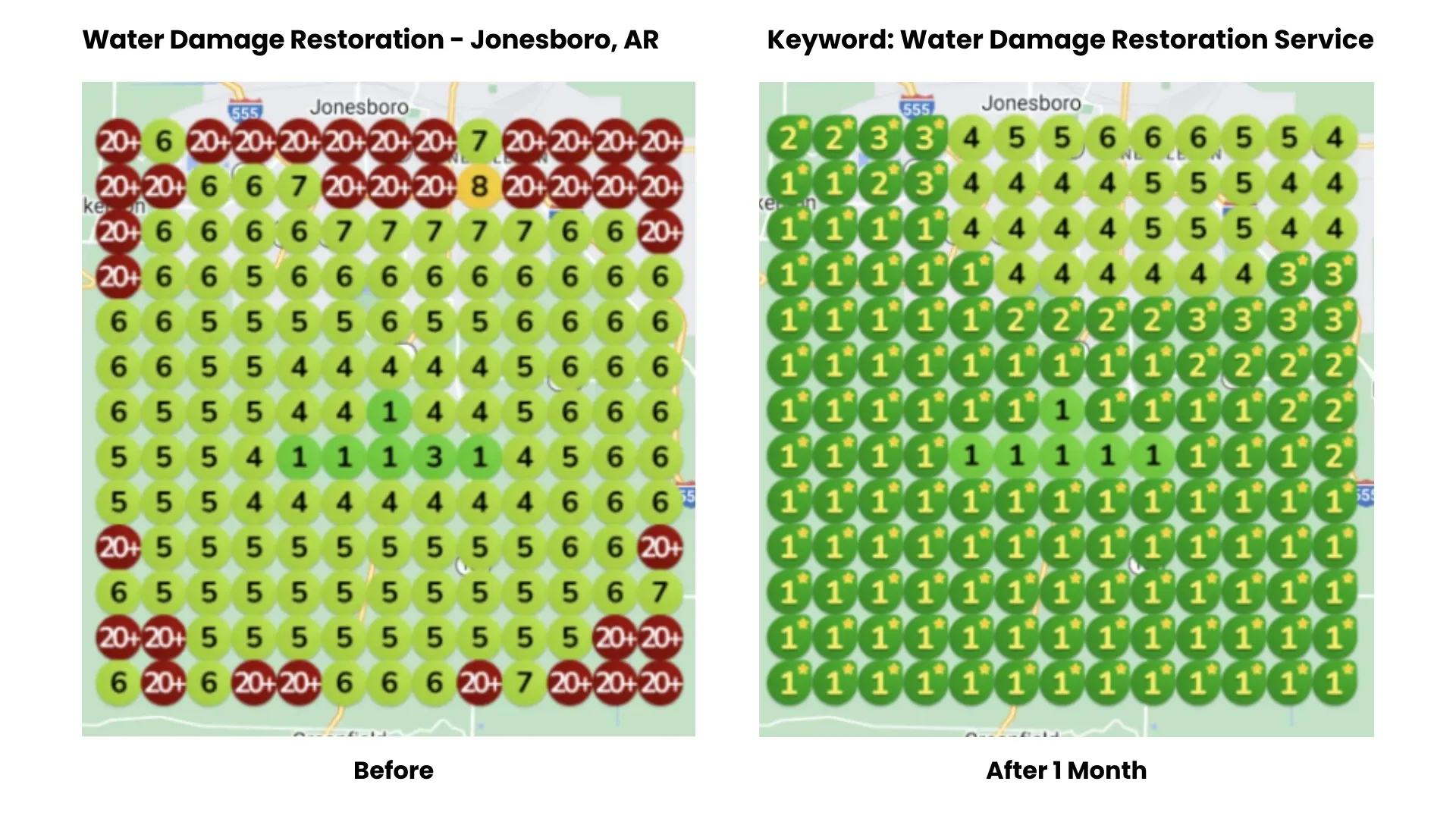
That is a real 13 by 13 scan, 169 checkpoints, for a water damage restoration company in Jonesboro, Arkansas. Read the left panel first, because it is the situation most contractors are actually in without knowing it.
The keyword scanned was "water damage restoration service," and that matters, because a grid measures one search term at a time. This is not a summary of everything that company ranked for. It is one phrase, mapped across one market.
Six of those 169 points sat in the top three. Six. Thirty-six came back at 20 or worse, meaning that across roughly a fifth of his own market the company did not appear at all. Everywhere else he was stuck at four, five, six: on the map, under the fold, invisible in practice. If he had checked from his desk he would have seen a one, because his desk sits inside the small green core at the center, and he would have concluded everything was fine.
The right panel is the same grid one month later. Every one of the 169 points ranks; the 20-plus dead zones are gone entirely. The worst position anywhere on the map is sixth. Around four out of five points sit in the top three, and roughly two thirds sit at number one.
One honest note on that timeline. A month is fast, faster than we would ever promise, and it happened because the profile had specific fixable problems rather than a shortage of authority. Read it as evidence that the grid responds to profile work, not as a schedule.
That picture reframes every spending decision after it. If the green blob is small but solid, your profile is working and your problem is reach. If the blob is patchy even next to your own address, something is wrong with the profile itself and buying reach would be throwing money at the wrong problem. You cannot tell those two situations apart from a single search on your phone, and they call for opposite responses.
What Google Deleted in 2025
Google's local ranking page names three factors, and they have not changed: relevance, distance, and prominence. What changed is what got removed.
Until July 2025, that page also carried this sentence: "Your position in web results is also a factor, so search engine optimization (SEO) best practices apply."
Go read the page today. The phrase "search engine optimization" does not appear on it. Neither does the abbreviation. Neither does "position in web results." In the same edit, the description of prominence narrowed from links, articles, and directories down to the current wording: "how many websites link to your business and how many reviews you have."
Now the discipline. Google has said nothing about why, and a documentation change is not an algorithm change. Anybody telling you this proves organic ranking stopped mattering for local results is inventing a conclusion the evidence does not support. What you can say is narrower and more useful: Google no longer tells contractors that their website's ranking is a local ranking factor, and it now describes prominence almost entirely in terms of links to your business and reviews of it.
If you are deciding where to put the next dollar, that shift is worth noticing. It does not license you to abandon your website.
The Three Factors, Sorted by What You Can Actually Move
Distance. Zero control. Covered above. No setting, no purchase, no tactic. It is geometry. The only real lever is where your business is physically based, which is a decision most contractors made years ago for reasons that had nothing to do with search.
Relevance. High control, and this is where most contractors leave the most on the table. Google's wording: relevance is "how well a Business Profile matches what someone is searching for," and to help, "provide complete and detailed business info." In practice the heaviest single item here is your primary category, because it determines which searches you are eligible for at all. A drain specialist filed under General Contractor is not losing on ranking. He is not in the race. The mechanics of getting categories, services, description, and hours right are in our guide to optimizing a Google Business Profile for home services.
Prominence. Moderate control, slow, and the real long game. Google names two inputs: how many websites link to your business, and how many reviews you have. Links come from being a real business in a real place, sponsoring things, being quoted, appearing in local press and supplier directories. Reviews come from asking every customer, every job, without filtering, and the rules on that changed in April 2026. We covered the current version in the guide to getting more Google reviews for home service businesses.
Notice what is not on Google's list: posting frequency, photo cadence, keyword stuffing in your business description. Those show up in checklists constantly. Google does not name any of them here.
The Service Area Trap, and the Two Hour Rule
Here is the most expensive misunderstanding in this category.
Adding cities to your service area does not make you rank in those cities. Google's service area documentation describes what a service area does: it "helps people find your Business Profile" and "shows customers where you can provide your products and services." Nowhere does Google state that it extends your ranking radius, and the Distance factor still refers to distance from the searcher with no service area exception.
Google also publishes hard limits most contractors have never read. You cannot set a service area as a radius. You must specify by city, postal code, or similar. You get up to 20 service areas. And from the guidelines for representing your business: "The boundaries of your profile's overall service area shouldn't extend farther than about 2 hours of driving time from where your business is based."
Two hours of driving. That is the published outer edge, and it is generous compared to where most contractors actually rank, which is closer to fifteen minutes.
If you want visibility in a city you are not near, the answer is not a checkbox. It is real content on your website about that city, real work performed there, and eventually a real presence. There is no shortcut, and the checkbox is not one.
Why the Ranking Factor Lists Are Not What You Think
You will find "the top local ranking factors for 2026" everywhere, usually citing the same source, usually presented as though somebody measured something.
The most-cited one is Whitespark's Local Search Ranking Factors, published November 2025. It is worth reading and it is genuinely useful. It is also, by its own description, a survey of 47 local search experts who each scored 187 factors. Its top five for the map pack come out as primary category, proximity of address to the point of search, keywords in the business title, physical address in the city of search, and whether the business is open at the time of search.
That is a well-informed poll of practitioners. It is not a measurement of Google, and it is not a correlation study. Treat it as the collective hunch of people who look at this daily, which is worth a great deal, and not as evidence, which it does not claim to be.
Worth knowing alongside it: there is no current large-sample correlation study of local pack ranking factors. We looked. What comes up instead is a layer of aggregator blogs restating each other with no original data. When somebody quotes you a percentage for how much reviews influence map ranking, ask where the number came from. Usually the answer is nowhere.

What Is Actually Changing in 2026
Three things, and they pull in different directions.
The pack still shows up for real local intent. Whitespark's study of 540 queries, published May 2025, found local packs on 93 percent of local-intent searches, against 6 percent of informational ones. When somebody types a service and a city, they still get a pack. Worth noting the date on that data, because nobody has replicated it with intent segmentation since.
AI local packs are shrinking the field. The Sterling Sky numbers at the top of this article. They appeared on about 7 percent of tracked keywords as of mid 2026, which is small, and they show one or two businesses instead of three, which is not. If that share grows, the practical effect is fewer contractors visible per search.
Paid results are taking more of the space. Sterling Sky reports ads in the local pack went from about 1 percent of their tracked reports at the start of 2025 to roughly 22 percent by December. That squeezes the organic pack regardless of how well you optimize.
And a line worth quoting to anyone who suggests spending your way past it, straight from Google's ranking page: "There's no way to request or pay for a better local ranking on Google." Advertising buys placement. It does not buy the pack.
The Order To Do This In
Sequence matters more than effort here, because two of these steps are cheap and reveal whether the expensive ones are even necessary.
One. Get a grid scan before you change anything. You need the picture of where you rank across your service area, not a search from your shop. Without it you are guessing at which problem you have.
Two. Fix the primary category. It is one field, it takes two minutes, and it determines eligibility. Check what the businesses currently ranking above you are using.
Three. Complete the profile properly. Services, description, hours, attributes, photos. Google's own instruction under relevance is to "provide complete and detailed business info," and complete beats clever.
Four. Start the review habit and do not stop. Prominence is one of three factors and reviews are half of what Google names inside it. This is a compounding asset that takes months, which is exactly why it should start now rather than after everything else.
Five. Earn links to the business. Sponsorships, suppliers, local press, trade associations, the chamber. Slow, unglamorous, and the half of prominence almost nobody works on.
Six. Re-scan the grid. Same keyword, same tool, same grid. The only proof that any of this worked is the picture changing, and you cannot see that without step one.
Notice that steps one and six are the same action. That is not an accident. Everything in the middle is a hypothesis until the second scan tests it.
What This Will Not Do
It will not put you in packs across a metro you sit on the edge of. Nothing will. Distance is real and permanent, and any agency promising city-wide domination from one address is selling you a fight with geometry.
It will not work in ninety days for prominence. Categories and completeness can move within weeks. Links and reviews are slower, and anybody quoting you a fixed timeline for those is guessing.
And it will not tell you whether the map pack is even where your customers are. Some trades get most of their work from emergency map searches. Others get it from referrals and organic pages and, increasingly, from being cited in an AI answer. Deciding how much of your budget belongs in local search at all is a measurement question that comes before any of the six steps above. That is the work our local SEO service starts with, and you can see what the scans look like in our case studies.

Frequently Asked Questions
How do I rank higher in the Google map pack?
Google names three factors: relevance, distance, and prominence. Distance is not controllable. Move relevance by fixing your primary category and completing your business information, and move prominence with reviews and links to your business. Measure with a grid scan rather than a search from your own phone.
Why do I rank in the map pack at my shop but not across town?
Because distance is measured from the searcher, not from you. Your rank is different at every point on the map, and it typically fades with distance from your address. That is the system working as documented, not a problem with your profile.
Does adding service areas help me rank in those cities?
No. Google describes service areas as helping customers find your profile and see where you operate. It has never published that service areas extend your ranking radius, and the Distance factor makes no exception for them.
How far can my service area extend?
Google says the boundaries "shouldn't extend farther than about 2 hours of driving time from where your business is based." You can list up to 20 service areas, specified by city or postal code, and you cannot set a radius.
Did Google remove SEO from its local ranking factors?
Google removed a sentence from its local ranking help page in July 2025 that said your position in web results is a factor and SEO best practices apply. The words no longer appear on the page. Google has not said why, and a documentation change is not proof of an algorithm change.
How many businesses show in an AI local pack?
Sterling Sky's June 2026 research across 322 markets found they feature one or two businesses rather than three, and surface roughly a third as many unique businesses as traditional three-packs.
Do Google Business Profile posts improve map pack ranking?
Google does not name posting frequency as a local ranking factor on its ranking page. Posts are worth doing for the customer reading your profile. Treat claims that they move rankings as unproven.
Can I pay Google for better map pack placement?
No. Google states plainly: "There's no way to request or pay for a better local ranking on Google." Advertising buys ad placement above or inside the pack, which is a different thing from ranking in it.
How often should I run a grid scan?
Monthly is enough for most contractors, and quarterly is workable. What matters more than frequency is using the same keyword, tool, and grid every time, because a scan is only useful compared against the last one.
Is the map pack still worth it if AI is taking over search?
For genuine local intent, yes. The most recent intent-segmented study, from May 2025, found local packs on 93 percent of local-intent searches. The concern is not that the pack is disappearing. It is that the AI version shows fewer businesses.
See Your Actual Map, Not a Guess
Almost every contractor we talk to believes he ranks better than he does, and it is not ego. It is that the only test most people run is a search from the one location where the answer is guaranteed to look good.
On a free Local Lead Growth Session we run a real grid scan across your service area, show you exactly where you appear and where you vanish, name the contractors sitting in your holes, and tell you straight whether your profile, your prominence, or your address is the thing holding you back.
Book a Free Local Lead Growth Session
Veteran owned. One contractor per trade, per city. Backed by our 90-day guarantee.